The bed frame market sits at the intersection of furniture demand, housing decisions, and value-driven e-commerce.
These bed frame market statistics show a category shaped by price-sensitive shoppers, large online platforms, and long-running shifts in supply and import dynamics.
At a glance: bed frame market statistics 2026
Key takeaways:
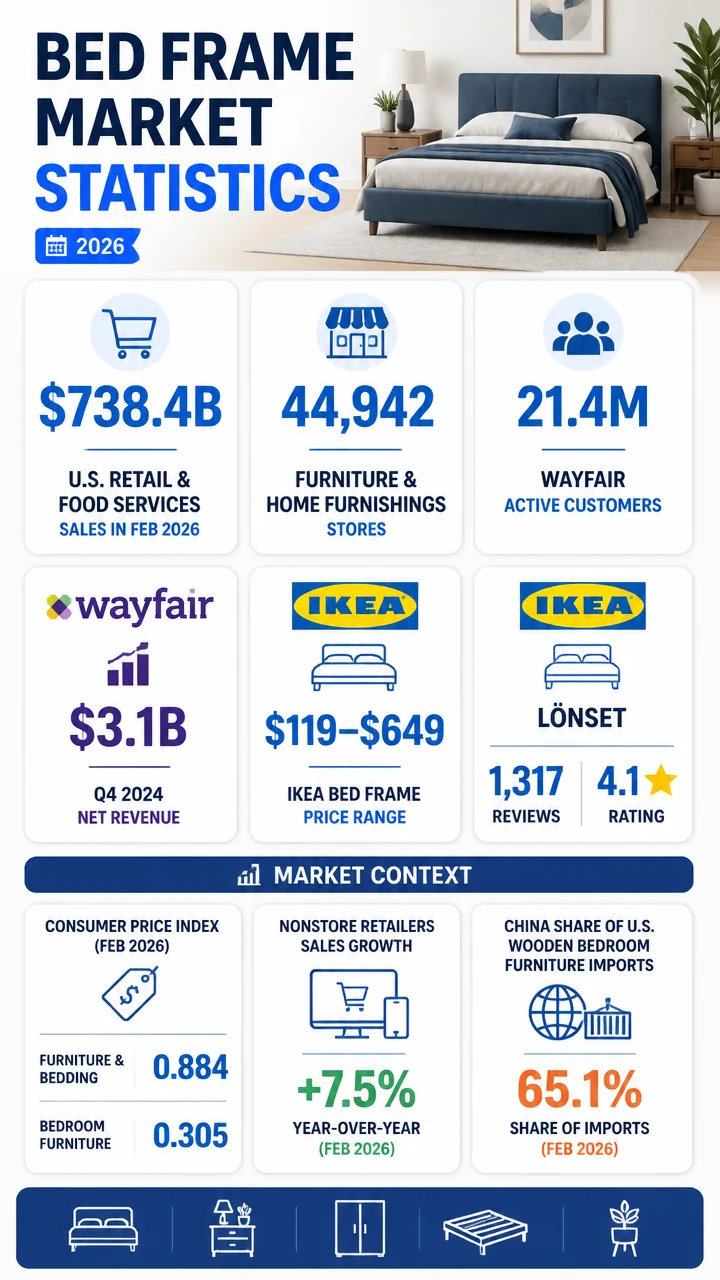
- 44,942 U.S. furniture and home furnishings stores operated as employer establishments in 2023.
- $738.4 billion in U.S. retail and food services sales was recorded in February 2026, up 0.6% month over month and 3.7% year over year.
- 21.4 million active customers were on Wayfair’s books at December 31, 2024.
- IKEA’s bed frame prices in this dataset range from $119 to $649.
- China’s share of U.S. wooden bedroom furniture imports reached 65.1% in January-June 2003.
Fast facts:
- 0.884 was the relative importance of furniture and bedding in the December 2025 CPI basket.
- 0.305 was bedroom furniture’s relative importance in the December 2025 CPI basket.
- Wayfair posted $3.1 billion in Q4 2024 net revenue.
- Natuzzi reported €318.8 million in consolidated revenue for 2024.
- IKEA’s LÖNSET queen slatted bed base has 1,317 reviews and a 4.1-star average.
Bed frame market statistics: what the category looks like right now
The bed frame market is not a niche backwater. It sits inside a broad U.S. furniture ecosystem with 44,942 employer establishments in furniture and home furnishings stores, and it benefits from steady consumer spending in a category that remains visible in household budgets.
Two CPI benchmarks underscore that visibility.
In December 2025, furniture and bedding held a 0.884 relative importance in the CPI basket, while bedroom furniture held 0.305.
Those figures are slightly different from December 2024, when furniture and bedding stood at 0.852 and bedroom furniture at 0.325.
The year-over-year movement suggests modest reshuffling inside the broader home-furnishings spend mix.
Why it matters: when a product category appears in both store counts and consumer price baskets, it is easier to see why pricing, assortment, and online convenience all matter at once.
Bed frame market trends in retail and consumer demand
The broader U.S. retail backdrop remains supportive.
In February 2026, U.S. retail and food services sales reached $738.4 billion, increasing 0.6% from the previous month and 3.7% from a year earlier.
That does not isolate bed frames specifically, but it tells you the consumer environment is still active.
Nonstore retail is especially important for bed frames because shoppers often compare dimensions, finishes, reviews, and delivery options online before buying.
In February 2026, nonstore retailers rose 7.5% year over year, reinforcing the role of e-commerce in furniture discovery and checkout.
Big number: 7.5% year-over-year growth for nonstore retailers signals that digital channels continue to outpace the broader market.
What the retail trend implies for bed frames
- Shoppers are increasingly comfortable buying bulky furniture online.
- Price comparison is easier, which raises pressure on both value brands and premium labels.
- Review volume and product clarity matter more because bed frames are purchased with fewer in-person touchpoints.
Bed frame market size and category benchmarks from CPI data
Inflation baskets do not measure the total market size directly, but they do show where consumer spending attention sits.
Bedroom furniture’s relative importance moved from 0.325 in December 2024 to 0.305 in December 2025.
Furniture and bedding moved from 0.852 to 0.884 over the same period.
That combination suggests a subtle shift: the broader furniture-and-bedding grouping gained weight, while the bedroom furniture slice slightly faded.
For bed frame sellers, that likely means shoppers are still buying into the category, but their spend may be spreading across more subtypes, bundled furnishings, or alternative product priorities.
| Category | December 2024 | December 2025 | Change |
|---|---|---|---|
| Furniture and bedding | 0.852 | 0.884 | +0.032 |
| Bedroom furniture | 0.325 | 0.305 | -0.020 |
At a glance:
- Broad furniture-and-bedding spending prominence ticked up.
- Bedroom furniture importance edged down slightly.
- Bed frame marketers should treat “bedroom furniture” as a competitive subcategory, not a standalone winner.
Bed frame market statistics from historical wooden bedroom furniture trade
The most revealing long-run signals come from the wooden bedroom furniture trade history.
The dataset shows a dramatic transition in the U.S. market from domestic production to import dependence, with China emerging as the dominant supplier.
U.S. producers’ domestic shipments fell from $2.500097 billion in 2000 to $2.077198 billion in 2002.
Over the same broad period, U.S. imports of wooden bedroom furniture from China jumped from $432.675 million in 2000 to $957.948 million in 2002.
Pull quote: China’s share of the U.S. wooden bedroom furniture import market climbed from 28.5% in 2000 to 51.6% in 2002.
Wooden bedroom furniture trade snapshot
| Measure | 2000 | 2001 | 2002 | Jan-Jun 2002 | Jan-Jun 2003 |
|---|---|---|---|---|---|
| U.S. producers’ domestic shipments | $2.500097B | $2.223842B | $2.077198B | $1.119686B | $958.913M |
| Imports from China | $432.675M | $565.551M | $957.948M | $404.700M | $624.601M |
| China share of U.S. imports | 28.5% | Not provided | 51.6% | Not provided | 65.1% |
By January-June 2003, China’s share of U.S. wooden bedroom furniture imports had risen to 65.1%.
That is a striking market concentration figure, especially when paired with the falling domestic shipment totals for U.S. producers.
Why it matters: for today’s bed frame market, this history helps explain why price competition, supply chain flexibility, and import exposure remain central themes.
Bed frame industry data: production, imports, and case outcomes
Wooden bedroom furniture was large enough to support detailed industry scrutiny.
In 2003, the U.S. industry shipped 12.6 million pieces of wooden bedroom furniture valued at $1.9 billion.
In the same year, total imports from China were valued at $1.4 billion.
The USITC case data also show the breadth of evidence collected: 49 U.S. firms provided questionnaire responses covering about 88% of estimated U.S. shipments, while the Chinese producer survey covered 154 firms accounting for about 62% of Chinese exports to the U.S. in 2003.
| Industry indicator | Value | What it suggests |
|---|---|---|
| U.S. industry shipments in 2003 | 12.6 million pieces | Large-scale domestic category output |
| U.S. industry shipment value in 2003 | $1.9 billion | Meaningful market size |
| China import value in 2003 | $1.4 billion | Import competition at major scale |
| Final dumping margins | 0.79% to 198.08% | Extremely wide outcome range |
Stat highlight: the final dumping margins in the 2004 USITC case ranged from 0.79% to 198.08% ad valorem, showing how severe the divergence could be across firms.
Bed frame market statistics by retailer: Wayfair’s scale and customer base
Wayfair is one of the clearest modern signals for how bed frames are sold online at scale.
In Q4 2024, the company generated $3.1 billion in net revenue, up 0.2% year over year.
U.S. net revenue reached $2.7 billion, rising 1.1%, while international net revenue fell to $381 million, down 5.7%.
Gross profit came in at $941 million, equal to 30.2% of total net revenue.
Wayfair also reported a $128 million net loss, alongside $96 million in non-GAAP adjusted EBITDA.
Big number: 21.4 million active customers were on Wayfair’s platform at December 31, 2024.
| Wayfair metric | Q4 2024 / Dec. 31, 2024 |
|---|---|
| Total net revenue | $3.1 billion |
| U.S. net revenue | $2.7 billion |
| International net revenue | $381 million |
| Gross profit | $941 million |
| Gross margin | 30.2% |
| Net loss | $128 million |
| Adjusted EBITDA | $96 million |
| Active customers | 21.4 million |
| LTM net revenue per active customer | $555 |
| Orders per customer | 1.85 |
For bed frame shoppers, Wayfair’s scale matters because it reinforces the importance of assortment depth, delivery convenience, and repeat buying behavior.
With 1.85 orders per customer in Q4 2024, the platform also shows how a broad home-furnishings retailer can support recurring purchases beyond a single bed-frame buy.
Bed frame market benchmarks from IKEA pricing and reviews
IKEA’s listings offer a useful benchmark for the value end of the bed frame market.
Prices in the dataset span from $119 for the TARVA full-size bed frame to $649 for the IDANÄS upholstered bed frame in queen size.
What makes these listings useful is the combination of price, review volume, and size options.
That mix shows how consumers compare not just cost, but perceived quality and format before buying.
| Product | Size | Price | Rating / Reviews |
|---|---|---|---|
| TARVA bed frame | Full | $119 | 695 reviews |
| VEVELSTAD bed frame | — | $149 | 4.4 stars from 244 reviews |
| VIHALS bed frame | Queen | $199 | 3.5 stars |
| SLATTUM upholstered bed frame | Queen | $299 | 4.2 stars from 394 reviews |
| MALM bed frame | King | $339 | — |
| IDANÄS bed frame | White queen | $469 | 4.1 stars from 155 reviews |
| IDANÄS bed frame with storage | Queen | $599 | 4.1 stars from 73 reviews |
| IDANÄS upholstered bed frame | Queen | $649 | 3.3 stars from 243 reviews |
Notable finding: the lowest listed price in this dataset is $119, while the highest is $649, a spread of $530.
Review-driven signals from IKEA listings
- LÖNSET stands out with 1,317 reviews and a 4.1-star average at $120.
- SLATTUM pairs a 4.2-star average with 394 reviews and a $299 price.
- VEVELSTAD has 4.4 stars from 244 reviews at $149.
- IDANÄS upholstered is the weakest-rated listed frame here at 3.3 stars, despite a premium $649 price.
That contrast is useful for SEO readers searching bed frame market statistics because it illustrates a classic furniture-market pattern: higher price does not guarantee higher perceived value.
Bed frame market demographics and product mix signals from size options
Size availability is a quiet but important indicator of category breadth.
In the dataset, IKEA listings show consistent coverage across queen, full/double, king, and twin formats.
Size coverage snapshot:
- VEVELSTAD offers queen, full/double, and king.
- TARVA offers full, king, and queen.
- LÖNSET is sold in queen, full/double, king, and twin.
- HEMNES appears in a twin-size configuration.
This kind of variety matters because bed frame demand is tied to household life stage and room size.
A twin frame serves a very different buyer than a king frame, and broad size coverage can widen the addressable market without requiring a totally separate product family.
Bed frame market statistics from Natuzzi: premium furniture as a demand signal
Natuzzi provides a premium-segment reference point for the broader bedroom and home-furnishings landscape.
In 2024, the company reported €318.8 million in consolidated revenue and €310.5 million in invoiced sales from upholstered and other home furnishings products after excluding €8.3 million of other sales.
Its U.S. and rest-of-Americas net sales of leather and fabric-upholstered furniture and beds plus home furnishings totaled €125.1 million in 2024.
Natuzzi also sold 196,210 seats, down 4.4% from 2023.
Why it matters: premium furniture numbers help frame the bed-frame market as part of a wider furnishing cycle, where upholstered and bedroom products can rise or soften together.
Bed frame market outlook signals hidden inside the numbers
The strongest pattern across these bed frame market statistics is the split between scale and specialization.
On one side, the market is anchored by large retail infrastructure, broad e-commerce reach, and historical import concentration.
On the other, consumers are making highly specific choices about price, size, material, and review quality.
Several figures stand out as especially useful for market watchers:
- 44,942 furniture and home furnishings store establishments show how broad the retail base remains.
- $738.4 billion in February 2026 retail and food services sales confirms a still-active consumer environment.
- 7.5% year-over-year growth for nonstore retailers underscores the continued shift toward digital shopping.
- 21.4 million Wayfair active customers show the reach of online home-furnishings retail.
- 65.1% China share of U.S. wooden bedroom furniture imports in January-June 2003 reveals how concentrated supply can become.
For anyone tracking bed frame market statistics, the story is not just about beds.
It is about the intersection of category pricing, consumer confidence, online discovery, import dependence, and product breadth across the entire furniture ecosystem.