Ashley Furniture is one of the clearest examples of scale in modern home furnishings.
From a workforce that grew from 35 employees to more than 35,000 worldwide, the brand’s footprint spans manufacturing, logistics, retail, sustainability, and community giving.
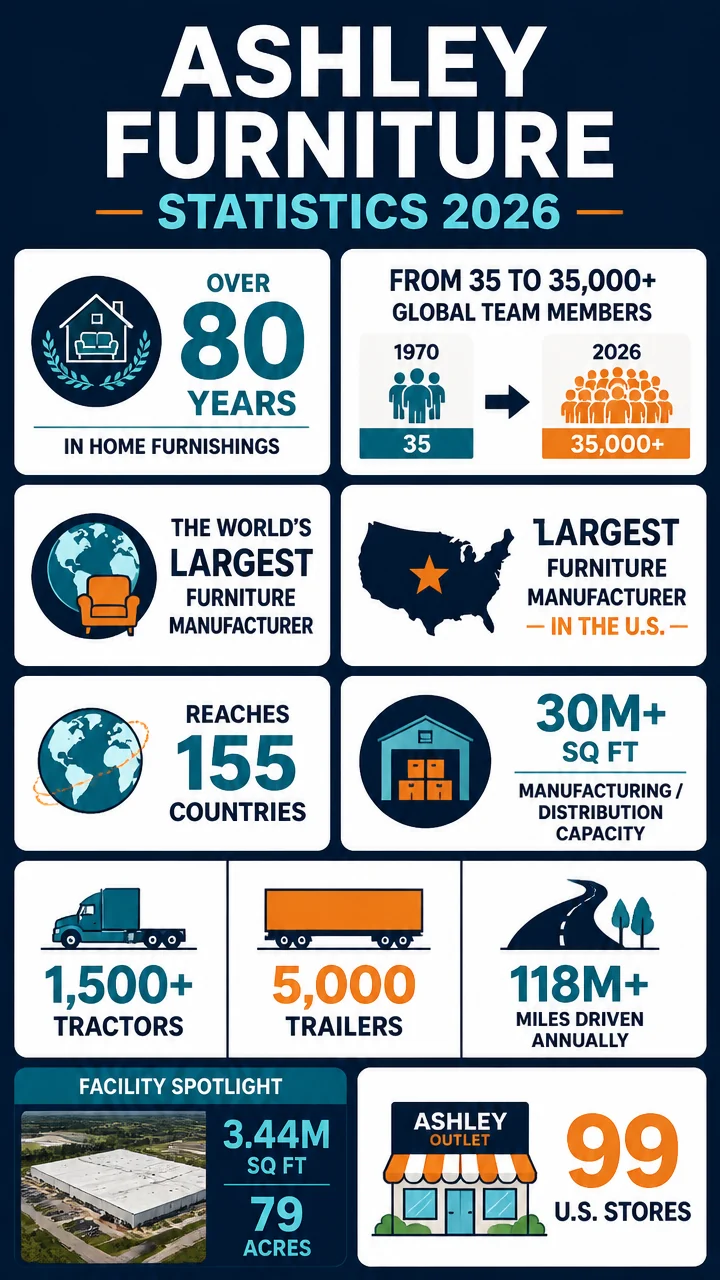
These Ashley Furniture statistics reveal a company built for volume: huge facilities, a massive fleet, broad U.S. retail coverage, and a global reach that extends to 155 countries.
Ashley Furniture statistics at a glance
Fast facts: Ashley is over 80 years old in home furnishings, reaches 155 countries, and is the world’s largest furniture manufacturer.
Big number: Ashley’s manufacturing and distribution capacity exceeds 30 million square feet.
Workforce growth: The company expanded from 35 employees in 1970 to over 35,000 team members globally.
Retail footprint: Ashley Outlet operates 99 stores across the United States.
Table of contents
- Ashley Furniture growth and company scale
- Ashley Furniture manufacturing and logistics statistics
- Ashley Furniture sustainability statistics
- Ashley Furniture community and philanthropy data
- Ashley Furniture Outlet store statistics
- Ashley Furniture offers and financing benchmarks
Ashley Furniture growth and company scale
Ashley’s scale is hard to miss: it is the world’s largest furniture manufacturer and the largest furniture manufacturer in the United States.
The company’s growth story is equally striking.
Ashley says it has been in home furnishings for over 80 years, and it went from just 35 employees in 1970 to over 35,000 team members globally today.
Why it matters: That combination of age, scale, and workforce growth helps explain how Ashley became a dominant furniture brand with a global operating model.
- Over 80 years in home furnishings
- 35 employees in 1970
- 35,000+ team members globally today
- 155 countries reached by the brand
- 30 million+ square feet of manufacturing and distribution capacity
| Growth metric | Stat | What it suggests |
|---|---|---|
| Company age | 80+ years | Long-running brand presence in home furnishings |
| Employees in 1970 | 35 | Very small early operating base |
| Current global team | 35,000+ | Large, multinational workforce |
| Countries reached | 155 | Broad international distribution |
| Facility capacity | 30 million+ sq. ft. | Massive production and logistics scale |
Key takeaway: Ashley’s growth is not just about brand recognition; it is about industrial-scale operations built to support wide distribution and high-volume production.
Ashley Furniture manufacturing and logistics statistics
Ashley’s logistics network is built like a national freight system. Its distribution and transportation operations include over 1,500 tractors and 5,000 trailers, and the fleet travels more than 118 million miles annually.
That mileage number is one of the most telling Ashley Furniture statistics in the dataset.
It signals constant movement between plants, warehouses, outlets, and customers across a wide geographic footprint.
Big number: More than 118 million miles traveled annually by Ashley’s fleet.
Major U.S. facilities
Ashley’s facilities show how aggressively the company has invested in domestic scale.
The largest U.S. furniture manufacturing and distribution facility was established in 2013 and measures 3,443,530 square feet, covering 79 acres under roof.
The company’s largest casegoods plant in the United States dates to 1970 and measures 2,928,800 square feet across 67 acres under roof.
Ashley’s largest upholstery facility in the United States was established in 1994 and measures 2,541,010 square feet, covering 58 acres under roof.
| Facility | Established | Square footage | Acres under roof |
|---|---|---|---|
| Largest U.S. furniture manufacturing and distribution facility | 2013 | 3,443,530 sq. ft. | 79 |
| Largest casegoods plant in the U.S. | 1970 | 2,928,800 sq. ft. | 67 |
| Largest upholstery facility in the U.S. | 1994 | 2,541,010 sq. ft. | 58 |
Additional facilities underscore the scale of Ashley’s manufacturing and distribution system:
- Ecru facility: established in 2004, with 1,721,000 sq. ft. and 40 acres under roof
- Mesquite facility: established in 2006, with 1,529,900 sq. ft. and 35 acres under roof
- Leesport facility: established in 2015, with 876,530 sq. ft. and 20 acres under roof
At a glance: Ashley’s biggest sites are measured in millions of square feet, not hundreds of thousands.
Logistics fleet highlights
- 1,500+ tractors in the distribution and transportation network
- 5,000 trailers in the fleet
- 118 million+ miles traveled annually
Why it matters: A fleet of this size implies a distribution model designed for national reach and regular replenishment, especially when paired with a 155-country footprint.
Ashley Furniture sustainability statistics
Ashley’s sustainability profile is anchored by logistics efficiency, recycling, and renewable energy planning. One of the standout figures is a 90% reduction in idle time for trucks using APUs, which points to meaningful operational efficiency gains.
Fast facts: Ashley’s solar initiative has a predicted future yield of 25 million kWh.
In 2025, Ashley’s U.S. facilities reported substantial recycling totals across multiple materials:
| Material recycled in 2025 | Tons |
|---|---|
| Wood | 90,772 |
| Cardboard | 14,680 |
| Poly-foam | 14,330 |
| Plastic | 1,141 |
| Metal | 472 |
Wood recycling dominates the list: 90,772 tons is far ahead of every other material category reported.
- 90,772 tons of wood recycled in 2025
- 14,680 tons of cardboard recycled in 2025
- 14,330 tons of poly-foam recycled in 2025
- 1,141 tons of plastic recycled in 2025
- 472 tons of metal recycled in 2025
The company also reports that Ashley and the Wanek family have invested over $750,000 in tree planting over the past 30 years.
Why it matters: The sustainability story is not centered on one initiative.
It combines logistics efficiency, recycling scale, renewable energy potential, and long-term tree planting support.
Ashley Furniture community and philanthropy data
Ashley’s community giving reaches children, students, and nonprofit partners. The company says Ashley’s Angels has benefited over 22,000 children, making it one of the most visible figures in its philanthropic profile.
Education is another major pillar.
Ashley and the Ronald & Joyce Wanek Foundation award over 100 students with a scholarship each year.
Employee giving also plays a role: Ashley employees have contributed over $2.5 million to charities through the dollar-a-week program.
| Community initiative | Donation or impact total | Since |
|---|---|---|
| Ashley’s Angels | $1,595,022 | 2003 |
| Le Bonheur Children’s Hospital | $404,602 | 2006 |
| St. Jude Children Research Hospital |
$370,164 | 2012 |
| Ronald McDonald House Charities | $98,427 | 2017 |
| Various local nonprofits | $66,747 | 2015 |
| Hope to Dream | $38,772 | 2021 |
Pull quote: Ashley’s Angels alone has generated $1,595,022 in donations since 2003.
- 22,000+ children benefited through Ashley’s Angels
- 100+ students receive scholarships each year
- $2.5 million+ donated by employees through the dollar-a-week program
Why it matters: These numbers show a community strategy that mixes direct giving, education support, and employee participation.
Ashley Furniture Outlet store statistics
Ashley Outlet operates 99 stores in the United States. That gives the brand a broad outlet presence with meaningful state-by-state concentration in a few markets.
North Carolina leads the country with 10 Ashley Outlet stores, followed by Illinois and Michigan with 7 each.
Wisconsin has 6, while Pennsylvania, Tennessee, and Texas each have 5.
| State | Ashley Outlet stores |
|---|---|
| North Carolina | 10 |
| Illinois | 7 |
| Michigan | 7 |
| Wisconsin | 6 |
| Pennsylvania | 5 |
| Tennessee | 5 |
| Texas | 5 |
| Iowa | 4 |
| South Carolina | 4 |
| Virginia | 4 |
Several states appear with smaller but still notable counts, showing the brand’s spread across the U.S. outlet map:
- 3 stores each: Arkansas, Georgia, Kentucky, Louisiana, New Mexico, Ohio
- 2 stores each: Alabama, Arizona, California, Connecticut, Florida, Minnesota, New Jersey, New York, Oregon
- 1 store each: Idaho, Maryland, Missouri, Montana, North Dakota, West Virginia
At a glance: The outlet footprint is widespread, but highly concentrated in a handful of states.
Fast fact: Ashley Outlet has at least one store in more than two dozen states, based on the provided location data.
Ashley Furniture offers and financing benchmarks
Ashley’s marketing numbers are also part of the story. The online welcome offer gives $50 off purchases of $999.99 or more, while the in-store financing offer runs for 60 months.
- $50 off online welcome offer on purchases of $999.99+
- 60 months for in-store financing
These figures may be small compared with Ashley’s manufacturing totals, but they matter because they show how the brand supports conversion across online and in-store channels.
Why it matters: For a company built on scale, even modest promotional terms can be meaningful when applied across a broad retail network and large customer base.
Ashley Furniture statistics that stand out most
- 35 employees in 1970 versus 35,000+ today is the clearest sign of long-term expansion.
- 3,443,530 square feet makes Ashley’s largest U.S. facility enormous by any retail-manufacturing standard.
- 118 million+ annual fleet miles shows the logistics engine required to support its distribution model.
- 90,772 tons of wood recycled in 2025 is the biggest single sustainability number in the dataset.
- 99 Ashley Outlet stores give the brand a sizable physical retail presence in the U.S.
- $1,595,022 in Ashley’s Angels donations since 2003 highlights the scale of its community program.
Pull quote: Ashley Furniture’s statistics point to an unusual combination of manufacturing power, logistics reach, and retail visibility at national and global scale.
Key takeaways:
- Ashley is both a legacy brand and an industrial-scale manufacturer.
- The company’s footprint spans massive facilities, a large fleet, and 155 countries.
- Its sustainability and community metrics show measurable activity beyond sales.
- Outlet store concentration suggests a carefully distributed U.S. retail strategy.
Ashley-branded stores may be owned and operated by Ashley Global Retail, LLC or independent licensees, which helps explain the brand’s broad retail presence.