Air purifier statistics at a glance
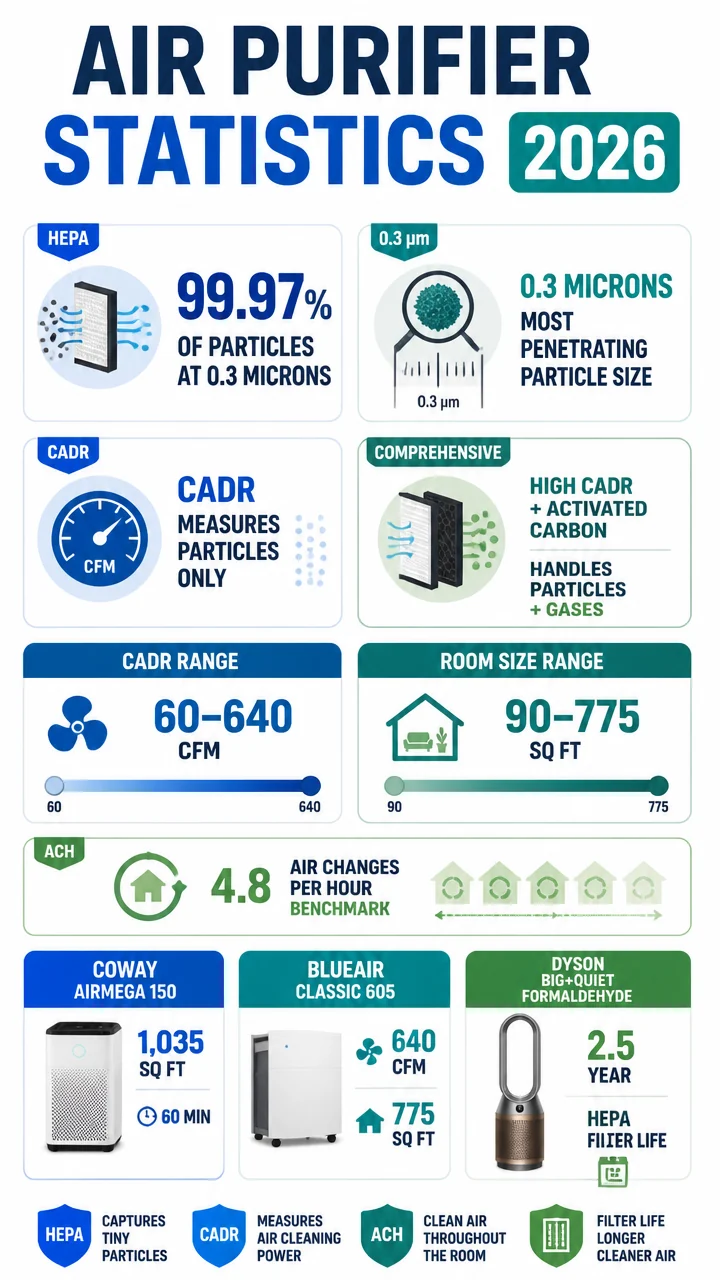
Air purifiers are easy to compare on paper, but the statistics that matter most are the ones that connect filtration efficiency, room size, noise, and airflow.
The latest product and agency data show just how wide the performance range can be.
- HEPA filters used in portable air cleaners are designed to remove at least 99.97% of dust, pollen, mold, bacteria, and other airborne particles at 0.3 microns.
- CADR rises with airflow: the higher the CADR, the more particles an air cleaner can filter and the larger the area it can serve.
- Portable air cleaners often reach high CADR levels by using HEPA filters, while activated carbon can help address gases as well as particles.
- Among the models in this dataset, CADR values range from 60 cfm to 640 cfm, showing a dramatic spread in output.
- Room-size recommendations vary from 90 sq ft to 775 sq ft, reflecting a huge difference in intended use.
- 4.8 ACH appears repeatedly as a benchmark across several Blueair and Coway models.
- Dyson’s Purifier Big+Quiet Formaldehyde uses a 2.5-year HEPA filter life, one of the longest filter-life figures in the dataset.
- Coway’s Airmega 150 can purify 1,035 sq ft in 60 minutes.
- Blueair’s Classic 605 reaches 640 cfm for pollen and is rated for 775 sq ft.
Contents
- HEPA filter statistics and what 99.97% really means
- CADR statistics, airflow, and room coverage
- Room-size benchmarks across leading air purifier models
- Noise, energy, and filter-life statistics
- Brand-by-brand performance comparisons
- Practical air purifier buying statistics
HEPA filter statistics: the 99.97% benchmark that defines the category
One statistic dominates air purifier marketing for a reason: HEPA filters in portable air cleaners are designed to remove at least 99.97% of dust, pollen, mold, bacteria, and other airborne particles at 0.3 microns.
That number is not just a label-friendly claim; it is the standard reference point for high-efficiency particle removal.
Why the 0.3-micron figure matters: EPA describes 0.3 microns as the most penetrating particle size.
In practical terms, larger or smaller particles are trapped at even higher efficiency, which makes the 0.3-micron benchmark a tough test rather than a soft one.
99.97% particle removal at 0.3 microns is the core HEPA stat behind many portable air cleaners.
Several product claims in the dataset reinforce how central HEPA remains:
- Dyson says its latest purifiers capture 99.97% of allergens and pollutants at 0.3 microns.
- Dyson says the Purifier Hot+Cool Gen1 removes 99.97% of particles as small as 0.3 microns.
- Dyson says the Purifier Big+Quiet Formaldehyde captures 99.97% of ultrafine particles as small as 0.3 microns.
- Coway’s Airmega 150 uses a 3-stage filtration system with a pre-filter, deodorization filter, and Coway HEPA filter.
If the goal is particle removal, HEPA is still the clearest statistical anchor in the market.
The rest of the spec sheet mostly explains how much air gets through that filter, how loudly it runs, and how large a space it can serve.
CADR statistics: the clearest way to compare air purifier output
EPA says CADR is the rating system for particles only, not gases.
It also notes that the higher the CADR, the more particles an air cleaner can filter and the larger the area it can serve.
That makes CADR one of the most useful apples-to-apples numbers in the category.
EPA also says portable air cleaners often achieve high CADR by using HEPA filters.
When a unit pairs a high CADR with an activated carbon filter, it can address both particles and gases.
- CADR measures particles, not gases.
- Higher CADR generally means broader room coverage.
- Fan speed and run time both increase the amount of air filtered.
- Many portable HEPA units list CADR in cubic feet per minute in the United States.
CDC notes that CADR is an established standard defined by the Association of Home Appliance Manufacturers, and that participating portable air cleaner manufacturers have products certified by an independent laboratory.
CDC also emphasizes that in-room HEPA units should be appropriately sized for the area where they will be installed.
CADR comparison table
| Model | CADR for pollen | CADR for dust | CADR for smoke | Recommended room size |
|---|---|---|---|---|
| Blueair Blue Pure Mini Max | 60 cfm | 60 cfm | 60 cfm | 90 sq ft |
| Blueair Blue Pure 511i Max | 174 cfm | 159 cfm | 153 cfm | 237 sq ft |
| Blueair Blue Pure 411i Max | 180 cfm | 163 cfm | 145 cfm | 225 sq ft |
| Blueair Blue Pure 311i Max | 365 cfm | 314 cfm | 283 cfm | 439 sq ft |
| Blueair Classic 605 | 640 cfm | 500 cfm | 500 cfm | 775 sq ft |
| Coway Airmega 150 | 220 | 161 | 153 | 214 sq ft |
The table shows a clear pattern: as CADR climbs, room coverage climbs too.
The smallest model in this set, Blueair’s Blue Pure Mini Max, is rated at 60 cfm across all three particle categories.
At the top end, the Blueair Classic 605 reaches 640 cfm for pollen and is recommended for 775 sq ft.
640 cfm is the highest CADR in the dataset, while 60 cfm is the lowest, creating a more than tenfold spread in particle delivery.
Air purifier room-size statistics: how much space each model is built to handle
Room-size guidance is one of the most practical statistics for buyers because it translates performance into real-world use.
The dataset shows a wide range of intended coverage, from compact bedroom-sized units to models for larger open rooms.
- Blueair Classic 605: 775 sq ft
- Blueair Blue Pure 311i Max: 439 sq ft
- Blueair Blue Pure 511i Max: 237 sq ft
- Blueair Blue Pure 411i Max: 225 sq ft
- Coway Airmega 150: 214 sq ft
- Blueair Blue Pure Mini Max: 90 sq ft
The gap between the smallest and largest room-size rating is striking: 775 sq ft versus 90 sq ft.
That is an 8-plus-times difference in intended coverage, which helps explain why air purifier shopping becomes so confusing so quickly.
Some of the model claims are especially useful for comparison:
- Blueair says the Blue Pure Mini Max can clean 107 sq ft at the AHAM recommendation of 4 air changes every 12.5 minutes.
- Blueair says the Blue Pure 411i Max can quickly clean 219 sq ft in 12.5 minutes, 500 sq ft in 30 minutes, and 1,000 sq ft in 1 hour.
- Blueair says the Classic 605 can rapidly clean 775 sq ft in 12.5 minutes, 1,800 sq ft in 30 minutes, and 3,600 sq ft in 1 hour.
- Coway says the Airmega 150 can purify 1,035 sq ft in 60 minutes.
Room-size numbers are not just marketing fluff; they tell you whether a purifier is built for a desk, bedroom, living room, or a much larger open space.
Noise, energy, and filter-life statistics buyers often overlook
Performance is only part of the story.
The best air purifier may still be a poor fit if it is too loud, uses too much energy, or demands frequent filter replacements.
Noise level statistics
Noise ratings in the dataset range from barely noticeable low settings to clearly audible maximum output.
For many shoppers, this is the tradeoff that determines whether a purifier runs continuously or only when needed.
- Blueair Blue Pure Mini Max: 20 to 44 dB
- Blueair Blue Pure 511i Max: 19 to 48 dB
- Blueair Blue Pure 411i Max: 18 to 46 dB
- Blueair Blue Pure 311i Max: 23 to 50 dB
- Blueair Classic 605: 33 to 62 dB
- Coway Airmega 150: 19.98 to 48.3 dB(A)
- Dyson Purifier Cool Formaldehyde: 46 dB maximum fan-speed sound level
Notable pattern: the larger-capacity units can reach louder top-end sound levels, but the low-end figures remain relatively modest for much of the category.
Energy consumption statistics
Energy use also varies significantly across the dataset, from compact units designed for smaller rooms to larger devices built for heavier airflow.
- Blueair Blue Pure Mini Max: 10 W
- Blueair Blue Pure 511i Max: 17 W
- Blueair Blue Pure 411i Max: 20 W
- Blueair Blue Pure 311i Max: 32 W
- Blueair Classic 605: 15 to 100 W
- Coway Airmega 150: 35 W
100 W is the top energy figure in the dataset, belonging to Blueair’s Classic 605 at its upper range.
Filter-life statistics
Filter replacement timing is another underrated buying variable.
Dyson says its Purifier Cool Formaldehyde has a one-year filter life based on 12 hours of use per day.
Dyson’s Purifier Big+Quiet Formaldehyde uses a 2.5-year HEPA filter life, while Coway says the Airmega 150 offers 6 months for deodorization and 1 year for HEPA.
Filter-life takeaway: longer filter life can reduce maintenance frequency, but replacement schedules still depend on usage patterns and air conditions.
Manufacturer comparisons: Blueair, Dyson, and Coway by the numbers
The dataset includes several brands, and the differences are not subtle.
Some models are optimized for compact rooms and low power draw, while others chase high CADR and large-area coverage.
| Brand | Model | Standout stats |
|---|---|---|
| Blueair | Blue Pure Mini Max | 90 sq ft recommended room size; 60 cfm CADR; 10 W; 20 to 44 dB; 2.8 lb |
| Blueair | Blue Pure 511i Max | 237 sq ft recommended room size; 174 cfm pollen CADR; 17 W; 19 to 48 dB |
| Blueair | Blue Pure 411i Max | 225 sq ft recommended room size; 180 cfm pollen CADR; 20 W; 18 to 46 dB |
| Blueair | Blue Pure 311i Max | 439 sq ft recommended room size; 365 cfm pollen CADR; 32 W; 23 to 50 dB |
| Blueair | Classic 605 | 775 sq ft recommended room size; 640 cfm pollen CADR; 15 to 100 W; 33 to 62 dB |
| Dyson | Purifier Cool Autoreact TP7A | 81 m3 test room; nine sensors; 20% quieter than Pure Cool TP04; 41 in high |
| Dyson | Purifier Cool Formaldehyde | 361 l/s max airflow; 46 dB max; one-year filter life; 4 oscillation angles |
| Dyson | Purifier Big+Quiet Formaldehyde | 99.97% capture at 0.3 microns; 23 gallons of airflow per second; 32 feet projection; 2.5-year filter life |
| Coway | Airmega 150 | 214 sq ft room size; 220 pollen CADR; 19.98 to 48.3 dB(A); 35 W; 12.1 lb |
Blueair’s range is especially broad. The same brand spans a 90 sq ft compact purifier and a 775 sq ft high-output model, with CADR scaling from 60 cfm to 640 cfm.
Dyson’s angle is different. Instead of leaning only on CADR, the dataset highlights sensor density, display data, oscillation angles, airflow in liters per second, and test methodology.
Dyson says its purifiers are tested in an 81 m3 room with nine sensors, compared with some other manufacturers using a 28.5 m3 chamber with one sensor.
Coway lands in the middle with a practical mid-room purifier that balances particle coverage and multi-stage filtration.
Its Airmega 150 offers 4.8 air changes per hour in a 214 sq ft room.
Practical air purifier buying statistics: what the numbers suggest
For shoppers and editors alike, the most useful air purifier statistics are the ones that help narrow the field fast.
The dataset points to a few clear buying rules based on measurable performance.
- Size the purifier to the room. CDC specifically says in-room HEPA air cleaners should be appropriately sized for the area where they will be installed.
- Use CADR as the comparison anchor. It is the clearest particle-based output stat in the category.
- Don’t confuse particles with gases. EPA says CADR is for particles only, so activated carbon matters if gas reduction is also a goal.
- Look at fan speed and runtime. EPA notes both increase the amount of air filtered.
- Check noise at the setting you will actually use. Quietness can determine whether an air purifier runs all day or sits unused.
Stat highlight: Blueair’s Classic 605, with 640 cfm pollen CADR, shows how much more throughput a large-room purifier can deliver than a compact model like the Blue Pure Mini Max at 60 cfm.
Another useful benchmark comes from ACH, or air changes per hour.
Several models in the dataset are rated at 4.8 ACH, which provides a standardized way to think about circulation rather than just raw airflow.
- Blueair Blue Pure Mini Max: 4.8 ACH
- Blueair Blue Pure 511i Max: 4.8 ACH
- Blueair Blue Pure 411i Max: 4.8 ACH
- Blueair Blue Pure 311i Max: 4.8 ACH
- Blueair Classic 605: 4.8 ACH
- Coway Airmega 150: 4.8 ACH in 214 sq ft
That repeated 4.8 ACH benchmark is a useful reminder that many manufacturers are designing around a similar circulation target, even if the room sizes and CADR outputs differ dramatically.
Two purifiers can both be “good,” but one may be tuned for a bedroom while the other is built for a living room or open-plan area.
The statistics above are what separate those use cases.
Air purifier performance benchmarks shoppers can quote
If you need the most shareable figures from this dataset, these are the ones that stand out immediately:
- 99.97% HEPA particle removal at 0.3 microns
- 640 cfm top CADR in the dataset
- 775 sq ft recommended room size for the Blueair Classic 605
- 1,035 sq ft in 60 minutes for the Coway Airmega 150
- 2.5-year HEPA filter life for Dyson’s Purifier Big+Quiet Formaldehyde
- 81 m3 Dyson test room with nine sensors
- 10 W energy consumption for the Blueair Blue Pure Mini Max
- 62 dB top sound level for the Blueair Classic 605
These numbers make the category easy to summarize: compact units are quiet and efficient, mid-size units balance room coverage and noise, and large-room models push hard on CADR and airflow at the cost of higher output and, often, more sound.
From 60 cfm to 640 cfm, the dataset shows more than a tenfold spread in air delivery capacity across popular purifier models.