Choosing the right bunk bed for a compact bedroom means balancing sleeping capacity, floor space, storage, safety, and everyday usability. The best designs make vertical space work harder without making the room feel crowded.
We’ve gathered 10 bunk beds for small rooms with practical features such as built-in drawers, stairs, trundles, charging stations, guardrails, and compact ladders. Use the guide below to narrow down the best fit for your room and household.
Best 10 Bunk Beds for Small Rooms Picks for 2026
Best Convertible Pick
Jocoevol Twin-Over-Twin Metal Bunk Bed

- Converts into two separate twin beds
- 16.5-inch guardrails and anti-tip device
- Reversible ladder with under-bed storage
Best For: Flexible shared rooms, dorms, and growing households
Best Budget-Friendly Space Saver
SHA CERLIN Twin-Over-Twin Bunk Bed

- 14-inch enclosed upper guardrails
- 400-pound capacity per layer
- 10.6 inches of under-bed clearance
Best For: Simple shared children’s rooms and compact bedrooms
Best Storage Upgrade
BTHFST Twin-Over-Twin Bunk Bed with Stairs

- Eight drawers for clothing, toys, and bedding
- Integrated stairs instead of a vertical ladder
- Remote- and app-controlled LED lights
Best For: Storage-focused children’s bedrooms and apartments
Best Whimsical Design
LIKIMIO House-Style Twin Bunk Bed

- Compact 76.8-by-40.7-inch footprint
- House-shaped white metal frame
- No box spring needed
Best For: Playful children’s rooms with limited floor space
Most Feature-Packed

- Built-in drawers, coat rack, pegboard, and charging hub
- RGB LED lighting with app and remote control
- 13-inch guardrails and anti-toppling device
Best For: Kids’ rooms and dorms needing integrated organization and charging
Best Layout Flexibility
Twin-Over-Twin Storage Bunk Bed

- Reversible six-drawer storage dresser
- Converts between bunk and loft-style configurations
- Low floor bed with full-length upper guardrails
Best For: Small rooms with changing layouts and storage needs
Best for Multiple Sleepers

- Sleeps three with twin-over-twin-over-twin configuration
- Charging station includes outlets, USB, and USB-C ports
- Converts into three separate twin beds
Best For: Families, sleepovers, and dorms needing three beds
Best for Kids' Storage
House-Style Twin-over-Twin Bunk Bed

- Storage staircase with drawers, cubby, and clothes rack
- Low 47-inch frame with full-length guardrails
- App-controlled RGB lighting with 60,000+ colors
Best For: Younger children needing accessible storage and a playful design
Best for Three Sleepers
Triple Twin Bunk Bed with Trundle

- Creates three twin sleeping areas
- 400-pound stated weight capacity
- Converts into two separate single beds
Best For: Families or guests needing maximum sleeping capacity
Best for Tech-Friendly Rooms
Industrial Twin-over-Twin Bunk Bed
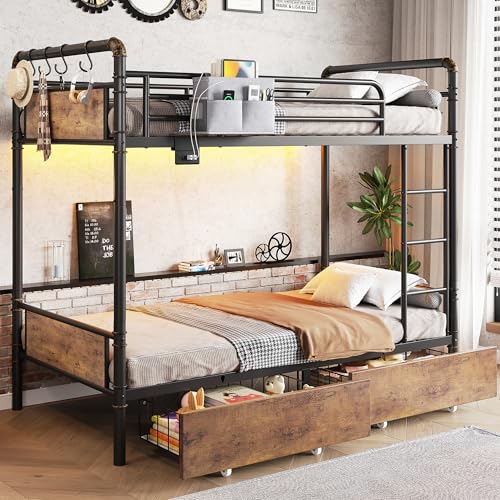
- Built-in drawers, hooks, and bedside storage bag
- Movable station with USB and USB-C charging
- RGB lighting and conversion to two twin beds
Best For: Shared rooms needing charging, storage, and flexibility
Best Convertible Pick – Jocoevol Twin-Over-Twin Metal Bunk Bed
For bunk beds for small rooms, the Jocoevol Twin-Over-Twin stands out because it can later separate into two single beds. Its metal frame, reversible ladder, under-bed clearance, and included bedside storage help make a compact bedroom more adaptable.
Best For: Families, dorm rooms, or shared bedrooms that need a convertible bunk with flexible placement.
Pros:
- Converts into two separate twin beds.
- 16.5-inch upper guardrails and an anti-tip device add stability.
- Reversible ladder and 11.2 inches of under-bed storage suit changing room layouts.
- Includes a bedside storage bag and four hooks.
Cons:
- The industrial vintage-brown finish may not suit every decor.
- Assembly is required, and the instructions advise leaving screws loose until setup is complete.
With a 440-pound lower-bed and 330-pound upper-bed capacity, this is a versatile choice when long-term flexibility matters as much as saving floor space.
Best Budget-Friendly Space Saver – SHA CERLIN Twin-Over-Twin Bunk Bed
The SHA CERLIN Twin-Over-Twin is a straightforward option for bunk beds for small rooms, combining a compact metal frame with 10.6 inches of space underneath. Its enclosed upper guardrails and inclined ladder make it practical for children’s shared bedrooms.
Best For: Families needing a simple, sturdy twin-over-twin bunk bed with accessible under-bed storage.
Pros:
- All four sides of the upper bunk use 14-inch guardrails.
- Metal slats support up to 400 pounds per layer and eliminate the need for a box spring.
- Inclined external ladder is designed for easier climbing.
- Ships with tools and step-by-step assembly instructions.
Cons:
- It does not convert into separate beds.
- The upper mattress must sit at least 5 inches below the guardrail’s top edge.
This modern black bunk keeps the design uncomplicated, making it a sensible fit when safety features and usable floor clearance are higher priorities than extra furniture features.
Best Storage Upgrade – BTHFST Twin-Over-Twin Bunk Bed with Stairs
The BTHFST bunk bed is designed for small rooms that need more than sleeping space. Its integrated staircase contains six fabric drawers, while two additional under-bed drawers and hanging organizers provide dedicated places for clothing, toys, books, and bedding.
Best For: Bedrooms where built-in storage, easier stair access, and playful lighting can replace separate storage furniture.
Pros:
- Provides eight drawers across the staircase and under-bed area.
- Wide integrated stairs offer an alternative to a vertical ladder.
- 13.4-inch guardrails and an included anti-tip kit support safer use.
- App- and remote-controlled LED lighting offers multiple modes and colors.
Cons:
- The storage-rich design may take more planning during assembly than a basic bunk frame.
- Its white, modern style and integrated lighting may not fit minimalist rooms.
This is the most feature-heavy choice in the group: a strong match when reducing clutter is central to choosing bunk beds for small rooms.
Best Whimsical Design – LIKIMIO House-Style Twin Bunk Bed
For bunk beds for small rooms, the LIKIMIO House Bunk Bed offers a compact footprint and a distinctive house-shaped frame. Its white metal construction, upper guardrails, and included ladder provide a practical foundation while leaving room for creative decorating.
Best For: Children’s rooms that need a space-saving twin bunk with a playful focal point.
Pros:
- Measures 76.8 by 40.7 inches, making it suitable for compact spaces.
- House-shaped design adds visual character and decorating potential.
- Metal slats require no box spring.
- Includes the parts, tools, and instructions needed for assembly in one box.
Cons:
- The design does not include built-in drawers or other storage features.
- At 71.7 inches high, ceiling clearance should be checked before purchase.
With a clean white finish and a 400-pound maximum recommendation, this bed balances a playful look with the basic functionality needed in a compact shared bedroom.
Most Feature-Packed – Itaar Twin-Over-Twin Bunk Bed
For shoppers comparing bunk beds for small rooms, this twin-over-twin Itaar model combines sleeping space with built-in organization and charging features. Its vertical design includes drawers, a coat rack, pegboard, and LED lighting in one footprint.
Best For: Kids’ rooms, dorms, or families wanting storage, charging, and lighting integrated into a bunk bed.
Pros:
- Combines four fabric drawers, a coat rack, pegboard, and charging hub.
- RGB LED lighting offers more than 60,000 colors and 29 flashing modes.
- Includes full-length 13-inch guardrails, an anti-toppling device, and a sturdy ladder.
- Offers two placement options and requires no box spring.
Cons:
- The 89-inch length may require careful room measuring.
- Assembly is required.
- The integrated features may be more than needed for a minimalist setup.
This is a strong choice when a small room needs more than just two beds. The integrated storage and charging station can reduce the need for additional furniture, while the steel frame and enclosed guardrails add practical safety features.
Best Layout Flexibility – Twin-Over-Twin Storage Bunk Bed
This twin-over-twin model is designed for bunk beds for small rooms where layout flexibility matters. Its reversible six-drawer storage unit can go on either side, and the lower bed can be converted to create open space underneath.
Best For: Small bedrooms with changing layouts, children or teens who need storage, and rooms that may benefit from a loft-style configuration.
Pros:
- Includes six fabric drawers and two open storage compartments.
- Reversible dresser can be installed on the left or right side.
- Can function as a standard bunk bed or convert to a loft-style setup.
- Low floor bed and full-length upper guardrails support a safety-focused design.
Cons:
- The 145-pound frame may be challenging to move during setup.
- Assembly is required.
- Its 74.8-inch length and 41.3-inch width still need to be checked against available space.
Among space-conscious options, this bed stands out for adapting to the room rather than forcing a single arrangement. The reversible storage dresser is especially useful when doors, windows, or walkways limit where furniture can go.
Best for Multiple Sleepers – Metal Triple Bunk Bed
For families or dorms that need to sleep three people, this triple bunk bed makes efficient use of vertical space. It includes a charging station and can be arranged as a U-shaped unit or separated into three twin beds.
Best For: Multi-person households, sleepovers, teens, and dorm rooms where three sleeping surfaces are needed.
Pros:
- Provides three twin sleeping spaces in one vertically oriented design.
- Includes two outlets, one USB port, and one USB-C port.
- Can be configured as a U-shaped triple bunk or three separate twin beds.
- Offers a 12-inch under-bed gap for blankets, toys, or seasonal storage.
Cons:
- Its 77.6-inch depth requires substantial floor space despite the vertical design.
- The product ships in two boxes that may arrive separately.
- Assembly is required.
This option is best when capacity is the priority. Its convertible design can remain useful after sleeping arrangements change, but shoppers should measure the room carefully because the footprint is deeper than many standard bunk beds.
Best for Kids' Storage – House-Style Twin-over-Twin Bunk Bed
For families comparing bunk beds for small rooms, this low-profile twin-over-twin model combines sleeping space with built-in organization. Its staircase includes hidden storage, while the house-shaped frame and optional RGB lighting add a playful touch to a children’s room.
Best For: Younger children who need accessible climbing, extra storage, and a fun bedroom design.
Pros:
- Storage staircase includes hidden compartments, two fabric drawers, an open cubby, and a clothes rack.
- Low 47-inch profile, 9.5-inch stair height, full-length guardrails, and an anti-tip device support safer use.
- RGB lighting offers app and remote control, more than 60,000 colors, and 29 flashing modes.
- Includes numbered parts and detailed instructions for two-person assembly.
Cons:
- The upper mattress should not exceed 6 inches thick.
- The 90.5-inch length and 79.5-inch height should be measured carefully before purchase.
This is a practical choice when a small room needs both bunk sleeping space and dedicated toy or clothing storage. The low design is especially appealing for younger climbers, though the taller overall footprint still requires careful room planning.
Best for Three Sleepers – Triple Twin Bunk Bed with Trundle
This triple bunk bed is designed for households that need multiple sleeping spots without adding several full-size bed frames. For bunk beds for small rooms, its twin-over-twin-over-twin layout and pull-out trundle make efficient use of vertical and floor space.
Best For: Families, guests, dormitories, and apartments that need three twin sleeping areas.
Pros:
- Provides three sleeping areas with a twin trundle.
- Heavy-duty metal frame and thick slats support up to 400 pounds according to the supplied specifications.
- Full upper guardrail, three-step ladder, anti-tilt device, and noise-reduction treatment add practical functionality.
- The bunk can be split into two single beds for added flexibility.
Cons:
- The triple configuration may feel tall or visually substantial in rooms with limited vertical clearance.
- Its 77.56-inch length and 61.61-inch width require careful floor-space planning.
Choose this model when maximizing sleeping capacity matters more than adding storage or decorative features. Its convertible design helps it adapt as family or guest-room needs change.
Best for Tech-Friendly Rooms – Industrial Twin-over-Twin Bunk Bed
For bunk beds for small rooms that need more than basic sleeping space, this twin-over-twin frame adds storage, charging, and adjustable lighting. Its industrial metal-and-wood look suits kids’ rooms, teen spaces, dormitories, and compact apartments.
Best For: Older children, teens, adults, or shared rooms where charging access, storage, and convertible design are priorities.
Pros:
- Two silent-glide drawers, a bedside storage bag, and four hooks help organize compact spaces.
- Movable charging station includes two USB ports, one USB-C port, and an 8-foot power cord.
- RGB lighting provides more than 16 million colors, 20-plus effects, app or remote control, and music sync.
- Converts into two separate twin beds and includes full-length 16.5-inch guardrails and an anti-tip kit.
Cons:
- The feature-rich design may be more than needed for shoppers seeking a basic bunk bed.
- Its industrial styling with brown wood panels may not suit every room decor.
This model stands out for compact rooms that also serve as study, entertainment, or shared living spaces. The charging station and storage reduce clutter, while the convertible frame offers useful long-term flexibility.
How We Picked the Best Bunk Beds for Small Rooms
We focused on features that matter most when floor space is limited: compact footprints, usable under-bed storage, sturdy materials, safe access to the top bunk, and flexible sleeping arrangements. The selection includes twin-over-twin frames, triple bunks, trundle models, and designs with stairs or integrated storage.
We also considered how each layout affects daily use. A ladder may save space, while stairs can be easier for younger children and provide drawers. Built-in lighting and charging ports can reduce the need for extra furniture, but they may add complexity and cost.
Quick Comparison
| Style | Best for | Main advantage | Potential trade-off |
|---|---|---|---|
| Twin-over-twin | Two sleepers | Compact, widely compatible mattress size | Less flexible than triple or trundle designs |
| Storage stairs | Kids’ rooms needing organization | Combines safer access with built-in storage | Usually takes more floor width |
| Trundle bunk | Occasional guests or siblings | Adds a third sleeping space when needed | Requires clearance to pull out the trundle |
| Triple bunk | Three sleepers in one room | Maximizes vertical capacity | Needs greater ceiling height and careful access planning |
| Metal bunk | Durability-focused shoppers | Often sturdy and visually lightweight | May transmit more movement or noise |
Key Buying Factors for Bunk Beds for Small Rooms
Measure the Complete Footprint
Measure the bed’s length and width, then account for ladder projection, stair units, trundle clearance, drawers, doors, and walking space. Leave enough room to change sheets and access windows, closets, and outlets. Check ceiling height carefully, especially for triple bunks.
Prioritize Guardrails and Access
Look for a full-length guardrail on the upper bunk and a firmly attached ladder or staircase. Confirm the recommended mattress thickness and age guidance in the manufacturer’s instructions. Stairs may be preferable when children need easier, more stable access.
Match Storage to the Room
Drawers, shelves, clothing racks, and under-bed compartments can replace a dresser, but make sure they open fully without blocking pathways. A trundle is useful only if there is sufficient clearance to pull it out and use it comfortably.
Check Construction and Setup
Compare the stated weight limits for each sleeping level, inspect the frame materials, and verify whether the bed requires wall anchoring. Metal frames can be durable, while wood-style designs may better suit rooms where reduced noise is important. Plan for careful assembly and periodic tightening of hardware.
Who Should Buy Which Bunk Beds for Small Rooms?
- For two children in a compact room: Choose a straightforward twin-over-twin design with a narrow ladder and strong guardrails.
- For a room short on storage: Select a model with stairs, drawers, a dresser, or a clothing rack, provided the added footprint fits.
- For frequent sleepovers: A trundle offers extra capacity without permanently taking up as much floor space as a third full-size bed.
- For three sleepers: Consider a triple bunk only after confirming ceiling clearance, upper-bunk access, and the manufacturer’s safety requirements.
- For tech-friendly kids’ rooms: LED lighting or USB and power features can be convenient, but keep cords managed and away from sleeping areas.
The best choice is the frame that fits the room with safe clearance, supports the intended sleepers, and adds useful functionality without making everyday movement difficult.