Closet Organization Statistics 2026: Why Storage Space Became a Home Feature Buyers Won’t Ignore
Closets may be one of the smallest spaces in the home, but the data shows they carry outsized weight in organization habits, home satisfaction, and buying decisions.
From storage bins to premium wood closets, the numbers point to one clear trend: people want closets that make life easier.
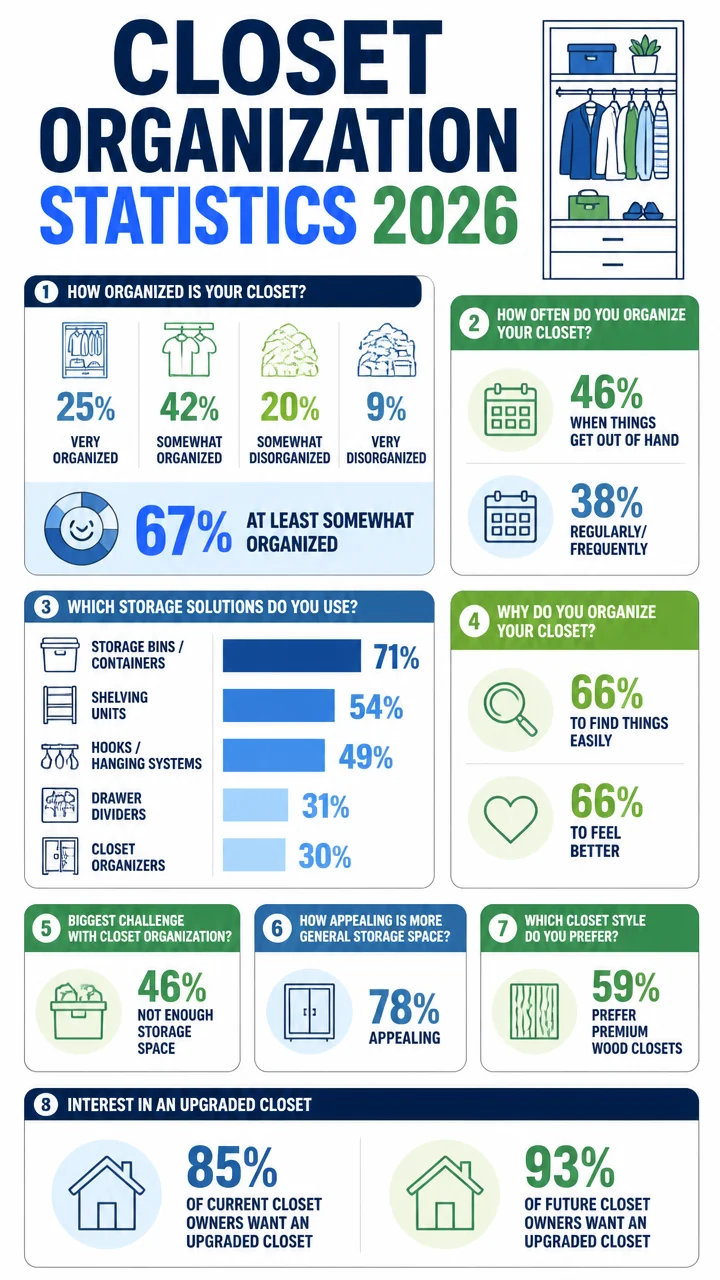
- 25% of respondents say their closets are very organized, while 42% call them somewhat organized.
- 71% use storage bins or containers for home organization, more than any other method listed.
- 78% of owners rate more general storage space as appealing in upgraded closets.
- 85% of owners want an upgraded closet, and 93% of future owners do.
At a glance
Big number: 78% say more general storage space is appealing in an upgraded closet.
Most common closet preference: 59% of owners prefer a premium wood closet.
Most common organizing trigger: 46% organize when things get out of hand.
Top challenge: 46% say not enough storage space is the biggest obstacle.
Closet Organization Statistics: How Organized Are Closets, Really?
Closets are not the most organized room in the house, but they are far from the least important.
In the YouGov home organization survey, only one in four respondents said their closets are very organized.
- 25% very organized
- 42% somewhat organized
- 20% somewhat disorganized
- 9% very disorganized
- 3% not sure
- 2% do not have closets
67% describe their closets as at least somewhat organized, but 29% say they are somewhat or very disorganized.
That gap matters because closets often function as daily-access storage for clothing, shoes, bags, and household overflow.
Closets sit at the intersection of everyday convenience and hidden clutter.
When closet storage fails, the whole home tends to feel less organized.
Closet Organization Statistics and Room Rankings: Where Closets Stand Against the Rest of the Home
Compared with kitchens, bathrooms, and living rooms, closets are not the best-organized spaces in the house.
The YouGov survey shows several rooms outperform them on the “very organized” measure.
| Room | Very organized |
|---|---|
| Living room | 45% |
| Bathroom | 44% |
| Kitchen | 42% |
| Dining room | 37% |
| Bedroom | 33% |
| Laundry room | 32% |
| Closet | 25% |
Closets rank below every listed main living area, including the bedroom and laundry room.
That suggests closet organization is still a common weak spot even in homes that feel otherwise well maintained.
The contrast is even sharper in other parts of the home:
- 31% say other bathrooms are very organized.
- 25% say other bedrooms are very organized.
- 18% say home offices are very organized.
- 12% say garages or sheds are very organized.
- 8% say basements are very organized.
Closet Organization Statistics: How Often People Organize Their Homes
Closet organization is rarely a one-time project.
Most households either stay on top of organizing regularly or wait until clutter becomes impossible to ignore.
- 38% organize regularly and frequently
- 46% organize when things get out of hand
- 8% organize once or twice a year
- 3% do not really organize
- 6% are not sure
84% of households either organize regularly or reactively when clutter gets bad.
Only a tiny 3% say they do not really organize at all.
46% are reactive organizers, meaning they wait until clutter forces action.
38% are frequent organizers, the only group that can plausibly keep closets in shape long-term.
Closet Organization Statistics: The Tools People Use Most
When people do organize, they rely heavily on physical storage solutions rather than apps or digital tools.
The top methods are practical, visible, and easy to buy.
| Home organization method | Share using it |
|---|---|
| Storage bins or containers | 71% |
| Shelving units | 54% |
| Hooks or hanging systems | 49% |
| Drawer dividers | 31% |
| Closet organizers | 30% |
| Labels | 21% |
| Decant products into uniform containers | 17% |
| Home organization app | 3% |
Storage bins and containers lead by a wide margin, used by more than seven in ten respondents.
By contrast, only 3% use a home organization app, showing that closet organization is still overwhelmingly a physical-storage problem.
- 71% storage bins or containers
- 54% shelving units
- 49% hooks or hanging systems
- 31% drawer dividers
- 30% closet organizers
Closet Organization Statistics: Why People Organize in the First Place
The most common reasons for home organization are functional and emotional, not cosmetic.
Closets are organized to make life simpler and calmer.
- 66% to find things easily
- 66% because they feel better when it is organized
- 61% to reduce clutter
- 38% to make it look good for guests
- 26% because they enjoy organizing
- 10% to prepare for a life change
- 9% because of pressure from others in the home
- 6% none of these
Function and feeling tie at the top: people organize both to find things faster and to feel better mentally when their space is under control.
That makes closet organization as much about stress reduction as storage.
“66% organize to find things easily, and 66% do it because they feel better when the home is organized.”
Closet Organization Statistics: The Biggest Barriers to a Tidy Closet
Most closet problems are not about style.
They are about space, accumulation, and decision fatigue.
| Top organization challenges | Share reporting the issue |
|---|---|
| Not enough storage space | 46% |
| Too many belongings | 41% |
| Difficulty letting go of things | 37% |
| Lack of motivation | 37% |
| Other people in the home | 26% |
| Not enough time | 25% |
| Not knowing where to start | 23% |
| None of these | 13% |
Not enough storage space is the leading barrier, narrowly ahead of having too many belongings.
That is a crucial clue for anyone trying to sell closet systems: people are not only looking for prettier shelving, they are trying to solve capacity problems.
Closet organization products that expand usable storage are likely to outperform purely decorative upgrades because the main pain points are practical.
Closet Organization Statistics: What Homeowners Want From Upgraded Closets
The closet upgrade data is especially strong.
Homeowners do not just like upgraded closets in theory; they actively want them and are willing to pay more for them.
- 75% of surveyed homeowners have or want an upgraded closet in their newly built home.
- 85% of owners want an upgraded closet.
- 93% of future owners want one.
- 78% of owners say they would pay more for upgraded closets.
- 87% of owners in the payment section say they would pay more.
The biggest appeal drivers are all storage-related:
- 59% say more storage space is a top reason upgraded closets are appealing.
- 52% say they make organizing easier.
- 51% want customization to fit their needs.
- 48% want more hanging space.
That pattern shows closet upgrades are not niche luxury features.
They are practical improvements tied to everyday usability.
Closet Organization Statistics: The Most Appealing Closet Features
When homeowners evaluate upgrade features, they consistently gravitate toward flexibility and capacity.
| Upgraded closet feature | Appealing to owners |
|---|---|
| More general storage space | 78% |
| More hanging storage | 76% |
| More shoe storage | 71% |
| Accessory storage | 69% |
| Flexible spacing or arrangement | 69% |
| Drawers | 69% |
| Lighting upgrades | 68% |
| Sliding shelves or organizers | 68% |
| Mirror with lights | 67% |
General storage space leads the list at 78%, but the rest of the rankings show a clear theme: buyers want closets that are easier to use, easier to see into, and easier to customize.
Closet Organization Statistics: Premium Wood Closets and Design Preferences
Among closet type preferences, premium wood closets dominate the field.
They are not only preferred; they also score well on aesthetics and storage usefulness.
- 59% prefer a premium wood closet
- 20% prefer a hang closet
- 4% prefer a double-hung closet
- 2% prefer a wooden closet
- 2% have no preference
- 68% choose the premium wood closet overall preference cluster shown in the study figure
| Why people like the premium wood closet | Share saying yes |
|---|---|
| Like the design | 66% |
| Like the way it looks | 65% |
| Has enough storage space | 56% |
| Value ease of organization | 55% |
| Like the material | 46% |
| Enough hanging space | 42% |
| Allows DIY features | 31% |
| Simple | 26% |
Design matters, but storage still wins.
Even the aesthetic favorite gets its strongest support from practical traits like enough storage space and enough hanging space.
Closet Organization Statistics: How Much Buyers Will Pay for Better Closets
Closet upgrades are one of the few home features that people attach a measurable premium to.
The ClosetMaid study found that homeowners are willing to pay 11% more for newly built homes with upgraded closets, equal to an estimated $39,289 increase in home cost and a $175 increase in rent for future homeowners.
- 87% of owners say they would pay more for upgraded closets.
- 78% of current owners would pay more.
- 93% of future owners would pay more.
- Current owners paid 13% more on average for upgraded closets in a newly built house.
- Future owners are willing to pay 10% more.
Homeowners and renters are willing to pay an 11% increase in mortgage or rent for the premium wood closet, representing at least a $200 increase in mortgage.
That is a meaningful signal that closet storage is not treated as a minor finish item.
$39,289 is the estimated home-cost increase tied to upgraded closets in the study.
Closet Organization Statistics: Who Responded in the ClosetMaid Study
The ClosetMaid survey sample helps explain why closet features resonate so strongly.
It includes many households with purchasing power, household responsibilities, and space-related needs.
| Respondent profile | Share |
|---|---|
| Employed full-time | 61% |
| Own their house | 48% |
| Rent an apartment | 31% |
| Rent a house | 21% |
| Primary decision maker for household purchases | 83% |
| Married or living as married | 53% |
| Single | 36% |
| Have children 12 or younger | 37% |
| Have children 13 to 18 | 24% |
| No children living with them | 49% |
Additional household context from the same study:
- 21% live alone.
- 47% live with 2 or 3 people.
- 33% live with 4 or more people.
- 40% have a 2-year or 4-year degree.
- 20% have some college or post-secondary technical training.
- 20% have a high school diploma or GED.
- 15% have a graduate degree.
Closet Organization Statistics: Children, Household Size, and the Organization Burden
Children make home organization noticeably harder for many households.
In the YouGov survey, respondents with children under 18 were far more likely to say children complicate organization than simplify it.
- 3% say children make it much easier
- 6% say somewhat easier
- 17% say there is no difference
- 36% say somewhat more difficult
- 36% say much more difficult
- 2% are not sure
52% of parents in the survey say children make home organization more difficult overall.
That is a major reason closet systems that simplify sorting, labeling, and access may be especially valuable in family homes.
- 11% say children are very involved
- 37% say somewhat involved
- 34% say not very involved
- 13% say not at all involved
- 5% are not sure
48% say children are very or somewhat involved in keeping the home organized, but that involvement does not erase the difficulty: the same households still report more strain than ease.
Closet Organization Statistics: Hoarding Awareness and Self-Perception
Closet clutter can sometimes be a mild annoyance, but for some people it connects to broader concerns about hoarding.
Most respondents do not know a hoarder personally, yet many know someone in their extended circles.
- 52% know no one who is a hoarder
- 26% know a family member who is a hoarder
- 10% know a friend
- 8% know an acquaintance
- 7% personally know a hoarder themselves
- 4% prefer not to say
On self-assessment, 10% think they could ever become a hoarder, while 71% say no.
Another 12% are not sure, and 7% say they are hoarders now and were not asked further.
Closet organization can be emotionally loaded.
For some households, the line between “messy” and “stressful” becomes part of the motivation to declutter.
Closet Organization Statistics: What Homebuyers Want in a New Home
Closets are a bigger selling point than many buyers admit.
Several housing studies show that buyers consistently rank storage and utility features near the top of their priorities.
- 86% of buyers rate a laundry room as desirable or essential in a new home.
- Two-thirds want linen closets and a walk-in pantry.
- More than 40% of first-time buyers consider a walk-in closet in the primary bedroom essential.
In the NAR study, buyers also showed a willingness to trade location for upgrades:
- 64% would sacrifice location for a move-in ready home.
- 54% would do so for at least one bathtub.
- 51% would do so for more space than their current residence.
- 44% would give up better schools and proximity to entertainment and shopping for certain upgrades.
- 44% would give up a location near public transportation.
And when buyers were asked what areas matter most, the ranking was clear:
| Most important home area | Share ranking it #1 |
|---|---|
| Kitchen | 29% |
| Bedroom | 22% |
| Living room | 18% |
Closets do not appear as a top area in that ranking, but the surrounding evidence suggests they are embedded in broader demand for storage, function, and move-in readiness.
Closet Organization Statistics: Market Trends Behind the Demand
Closet organization trends make even more sense when you look at broader housing patterns.
As homes get smaller and buyers become more cost-conscious, storage efficiency becomes more important.
- Median home size fell from 2,200 square feet in 2023 to 2,150 square feet in 2024.
- That 2024 figure was the lowest in 15 years.
- Townhomes reached a record 17% of the single-family market, up from 10% in 2009.
Smaller homes create more pressure on storage design.
As space gets tighter, the closet becomes less of a passive compartment and more of a make-or-break storage system.
Closet Organization Statistics: The Business Side of the Category
The closet organization market is supported by large-scale home improvement and storage companies, not just consumer habit.
ClosetMaid’s parent company, Griffon, reported $2.6 billion in fiscal 2024 revenue and $513.6 million in adjusted EBITDA.
Griffon said ClosetMaid was expected to generate approximately $300 million in revenue in the first 12 months after acquisition, with roughly $0.08 in EPS in the first full year of operations.
The company also says ClosetMaid sells closet organization, home storage, and garage storage products, while AMES sells wire and wood shelving, containers, storage cabinets, and other closet and home organization accessories.
- Griffon says major customer relationships average approximately 30 years.
- Named retail customers include Walmart, Target, Costco, Ace, Do-It-Best, and True Value.
That long customer lifecycle is another sign that closet and storage products are not one-off impulse buys.
They are recurring household purchases tied to renovation cycles, life changes, and new-home construction.
Closet Organization Statistics: The Most Surprising Patterns in the Data
- Closets are more often “somewhat organized” than “very organized”: 42% vs.
25%.
- People want closet upgrades for storage, not luxury alone: 78% prioritize more general storage space.
- Furniture-like design still matters: 66% like the design of premium wood closets.
- Parents face a heavier organization burden: 52% say children make organization harder overall.
- Professional organizers are barely used: only 3% get advice from them.
- Physical storage tools dominate: bins, shelving, and hanging systems far outrank apps.
“Closet organization is no longer just about tidiness; the data shows it is tied to storage, home value, and daily usability.”
Closet Organization Statistics: What the Numbers Say About the Future of Storage
The data points in one direction: consumers want closets that solve real-life storage problems and homebuyers are willing to pay for them.
The strongest signals come from the same place over and over again—space, convenience, and flexibility.
- Organizing is usually reactive, not perfectly routine.
- Closet clutter is often a capacity problem before it is a style problem.
- Upgraded closets rank highly because they improve usability.
- Families and future homeowners show especially strong demand for better storage.
For retailers, builders, and home organizers, the message is simple: closet organization is one of the clearest examples of a small space carrying a big consumer preference.