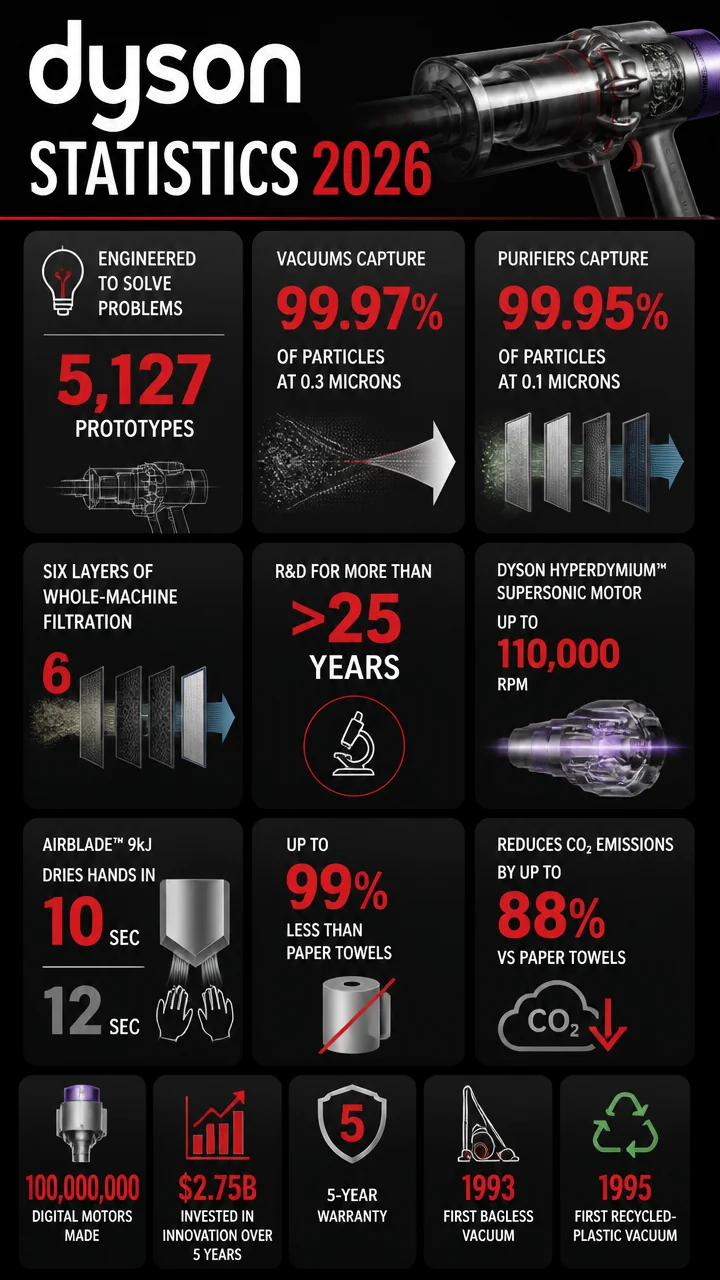
Dyson’s brand is built on extreme engineering, and the numbers behind it are just as aggressive as the design language.
From 5,127 prototypes to 100,000,000 digital motors, these Dyson statistics show a company obsessed with performance, filtration, and measurable claims.
Below, we break down the most important Dyson statistics by product line, technology, sustainability, and innovation investment.
Dyson statistics at a glance
Fast facts: Dyson says its vacuum and purifier filtration systems use six layers, its Airblade 9kJ dries hands in as little as 10 seconds, and its Supersonic motor spins up to 110,000 rpm.
- 5,127 prototypes were used to develop the first bagless vacuum cleaner.
- 99.97% is Dyson’s claimed particle capture rate for several filtration products at 0.3 microns.
- 88% less CO2 is the Airblade 9kJ’s claimed savings versus paper towels.
- 100,000,000 digital motors marks a major manufacturing milestone.
- 2.75 billion is Dyson’s announced investment plan into new technologies and products over five years.
Why it matters: Dyson doesn’t just sell appliances; it sells quantified performance.
That makes its statistics especially useful for comparing filtration, speed, energy use, and engineering scale across categories.
Dyson engineering statistics: prototypes, patents, and product development
5,127 prototypes is the headline number that best captures Dyson’s approach to product development.
That figure, tied to the first bagless vacuum cleaner, suggests a long, iterative process rather than a quick product launch.
Dyson says the first cyclonic bagless vacuum cleaner, the DC01, was developed in 1993.
That’s an important milestone because it helps explain why the brand’s identity still revolves around suction, separation, and dust capture.
Another early sustainability marker followed soon after: Dyson says it released its first vacuum made using recycled plastic, the Recyclone, in 1995.
That means recycled materials were already part of Dyson’s story in the mid-1990s, not just a recent marketing shift.
Big number: Dyson says one third of all Dyson people are engineers and scientists, underscoring how heavily the company leans into R&D talent.
- Dyson says its researchers work across 4 Technology Campuses.
- It says 6,000 engineers and scientists have access to hundreds of laboratories.
- Its UK Innovation Campus in Malmesbury and Hullavington has employed over 4,000 people.
- Dyson announced a £2.75 billion investment plan into new technologies and new products over the next 5 years.
Taken together, these figures point to a company built around continuous engineering rather than one-off product cycles.
Dyson filtration statistics: how the brand talks about clean air
Filtration is one of the strongest recurring themes in Dyson’s public statistics.
Across vacuums, purifiers, and hand dryers, Dyson repeatedly emphasizes layered filtration and very high particle capture rates.
Key stat: Dyson says its vacuum and purifier filtration technology is built from 6 layers and expels cleaner air.
That six-layer system appears across multiple Dyson products, giving the company a consistent technical story across categories.
| Dyson filtration claim | Figure | Product / context |
|---|---|---|
| Bagless vacuum filtration | 99.97% of particles as small as 0.3 microns | Vacuum cleaners |
| Purifier filtration | 99.95% of particles as small as 0.1 microns | Air purifiers |
| HEPA H13 filter | 99.97% of particles as small as 0.3 microns | Air treatment |
| Purifier allergen and pollutant capture | 99.97% of allergens and pollutants as small as 0.3 microns | Air purifiers |
| V15 Detect dust capture | 99.99% of dust particles down to 0.3 microns | Vacuum cleaner |
Notable takeaway: Dyson’s best-published dust capture figure in this dataset is 99.99% for the V15 Detect, while its purifiers are also positioned at the very high end with 99.95% capture at 0.1 microns.
- Dyson says its air purifiers can amplify airflow up to 15 times with Air Multiplier technology.
- Its purifier technology can also remove gases and odors while capturing fine particles.
- Dyson says its purifier filter frame is made from 85% recycled materials.
- Its technology has more than 25 years of research and development behind it.
Pull quote: “Dyson’s air purifiers capture 99.95% of particles as small as 0.1 microns.”
Dyson vacuum statistics: suction, capture, and connected cleaning
Dyson’s vacuum numbers focus on suction strength, filtration, and precision cleaning.
The most eye-catching in this dataset is the V15 Detect, launched with a team of 370 engineers globally.
Dyson says the V15 Detect generates up to 230 air watts of suction and captures 99.99% of dust particles down to 0.3 microns.
That combination of suction and capture is central to the brand’s premium cleaning story.
The company’s newest design language is also about compactness.
The PencilVac features a 38mm diameter body, making it a notable example of Dyson pushing toward slimmer form factors without dropping filtration performance.
| Dyson vacuum / cleaning product | Statistic | What it signals |
|---|---|---|
| First bagless vacuum development | 5,127 prototypes | Extreme iteration |
| DC01 launch year | 1993 | Category-defining origin |
| V15 Detect suction | Up to 230 air watts | High-performance cleaning |
| V15 Detect dust capture | 99.99% | Fine particle removal |
| PencilVac body diameter | 38mm | Ultra-slim design |
| PencilVac connectivity | MyDyson app compatible | Connected cordless cleaning |
- The PencilVac is Dyson’s first connected cordless vacuum.
- It connects to the MyDyson app.
- Dyson’s vacuum filtration approach remains tightly linked to its purifier engineering.
Why it matters: Dyson’s vacuum statistics aren’t just about power.
They combine suction, particle capture, compactness, and smart connectivity into a single product narrative.
Dyson purifier statistics: air quality by the numbers
Dyson’s purifier claims are among the clearest in the dataset.
The company says its purifiers capture 99.97% of allergens and pollutants as small as 0.3 microns, while also capturing 99.95% of particles as small as 0.1 microns.
That means Dyson positions its purification systems not just as airflow devices, but as fine-particle management systems.
The combination of HEPA H13 filtration, Air Multiplier airflow, and odor removal helps the brand compete in both consumer and premium indoor air markets.
- 99.97% capture at 0.3 microns appears multiple times across Dyson’s air and vacuum claims.
- 15x airflow amplification is used to describe Air Multiplier technology.
- 85% recycled materials in the filter frame add a sustainability layer to the product story.
At a glance: Dyson’s purifier statistics are strongest where air quality, filtration, and airflow overlap—especially at the sub-micron level.
Dyson Airblade 9kJ statistics: hand dryer speed, noise, and efficiency
The Airblade 9kJ is one of the most densely quantified Dyson products in the dataset.
It is both a speed story and an efficiency story, with numbers covering dry time, energy use, airflow, power, and footprint.
10 seconds in Max mode and 12 seconds in Eco mode are the simplest headline claims.
Dyson also says the unit is up to 99% less expensive than single-use paper towels.
| Airblade 9kJ metric | Max mode | Eco mode |
|---|---|---|
| Dry time | 10 seconds | 12 seconds |
| Rated power | 900W | 650W |
| Motor switching rate | 5,000 per second | 4,533 per second |
| Sound power level | 79 dB(A) | 76 dB(A) |
| Operating airflow | 5.3 gal/s | 4.8 gal/s |
| Energy / environmental comparison | Up to 88% less CO2 than paper towels | Up to 85% less CO2 than paper towels |
The Airblade 9kJ also has several hardware and installation figures that matter for facilities planning:
- 5-year warranty
- 2 modes: Eco and Max
- 2 machines supported on a dedicated 20 AMP circuit
- 4 inches deep
- 19.69 inches tall and 17.72 inches wide
- 9.92 lbs in weight
- 30-second operation lockout period
- 100-127V low-voltage input and 200-240V high-voltage input
- 50-60Hz operating frequency
- 32-104°F operating range
Pull quote: Dyson says the Airblade 9kJ uses just 9.1 kilojoules of energy per dry.
Dyson also says the hand dryer uses 2 curved apertures that create 374 mph sheets of air, while another sustainability stat in the dataset cites airflow reaching 388 mph.
Even without reading those figures as a direct apples-to-apples comparison, the message is clear: the Airblade 9kJ is engineered around high-speed air delivery.
Dyson Airblade 9kJ sustainability statistics
Dyson’s sustainability pitch for the Airblade 9kJ is unusually concrete.
Rather than broad environmental language, the dataset includes direct comparisons against paper towels and warm air dryers.
Key stat: Dyson says the Airblade 9kJ can use up to 88% less CO2 than paper towels and up to 87% less energy than warm air dryers in Eco mode.
- 99% less expensive than single-use paper towels.
- 88% less CO2 than paper towels.
- 85% less CO2 per dry than paper towels in Eco mode.
- 87% less energy than warm air dryers in Eco mode.
- 9.1 kilojoules of energy per dry.
These figures make the Airblade 9kJ one of the most clearly benchmarked products in the Dyson portfolio.
The comparisons are not just technical; they are procurement-friendly and easy to communicate in facilities, commercial, and sustainability contexts.
Dyson Supersonic statistics: speed, heat control, and styling results
Dyson’s hair-care stats show how the company turns motor performance into beauty claims.
The Supersonic professional hair dryer moves 13 liters of air per second, while the motor spins up to 110,000 rpm.
That high-speed motor is paired with tight thermal monitoring: Dyson says the Supersonic measures airflow temperature more than 40 times a second.
The product also includes 3 precise speed settings and 4 precise heat settings, suggesting control is as important as raw power.
| Supersonic statistic | Figure | Implication |
|---|---|---|
| Air moved per second | 13 liters | Fast drying |
| Motor speed | Up to 110,000 rpm | High-performance motor |
| Temperature checks | More than 40 times a second | Heat control |
| Weight | 1.8 lbs | Light handling |
| Power use | 1600W | High-output styling |
| Cable length | 9 feet | Salon usability |
| Sound level | 77 dBA | Measured acoustics |
Dyson also attaches strong beauty-result claims to the Supersonic:
- 75% increase in smoothness
- Up to 132% more shine
- Up to 61% less frizz and flyaways
- 82°F cold shot
Big number: The Supersonic’s 110,000 rpm motor is one of the most dramatic performance figures in the dataset.
Dyson WashG1 statistics: floor cleaning capacity and launch pricing
Dyson’s WashG1 brings wet floor cleaning into the statistics mix.
The product includes a 27 oz clean-water tank and claims coverage of flooring up to 3,100 sq. ft.
Those figures suggest a product designed for broad-area use rather than small spot cleaning.
Dyson also says the WashG1 will be priced at $699.99 and available in Fall 2024, which places it in the premium cleaning segment.
- 27 oz clean-water tank
- 3,100 sq. ft. coverage
- $699.99 launch price
- Fall 2024 availability
Dyson sustainability statistics: energy, materials, and long-term impact
Dyson’s sustainability stats extend beyond individual products.
The company says its lighting technology can maintain light quality for up to 60 years, a figure that frames longevity as a sustainability feature.
It also says its farming produces enough renewable energy to power the equivalent of 10,000 homes.
That is one of the largest system-level figures in the dataset and suggests Dyson wants its sustainability story to reach beyond appliances.
- Dyson’s Airblade 9kJ can use up to 88% less CO2 than paper towels.
- It uses 9.1 kilojoules per dry.
- Its purifier filter frame is made from 85% recycled materials.
- Its lighting technology can last up to 60 years.
- Its renewable energy output is enough to power 10,000 homes equivalent.
Why it matters: The strongest Dyson sustainability claims are built around measurable reductions, durable products, and recycled materials rather than vague brand pledges.
Dyson health and research statistics: beauty, habits, and funding
Dyson’s research story is not limited to machines.
The company says its 2022 hair study found that 8 in 10 people wash their hair every day or once every 2 days.
It also says 6 in 10 people globally changed their hair habits due to the pandemic, while at least 20% of consumers returned to pre-pandemic styling routines.
Those numbers help explain why Dyson continues to invest in hair tools and beauty innovation.
- 8 in 10 people wash hair every day or every 2 days.
- 6 in 10 people globally changed hair habits due to the pandemic.
- At least 20% returned to pre-pandemic styling routines.
Dyson also says the James Dyson Foundation funds a £1.5 million dementia research fellowship, adding a philanthropic layer to the company’s broader research footprint.
Dyson digital motor statistics: manufacturing scale and technical reach
Dyson’s motors are one of its defining technical assets.
The company says the first generation Dyson Digital Motor X020 was manufactured in Singapore in 2004, and it has since reached 100,000,000 Dyson Digital Motors and counting.
Milestone: 100 million digital motors is a major indicator of how central motor technology is to Dyson’s product ecosystem.
That scale helps explain why so many Dyson products can share engineering DNA across categories:
- Vacuums rely on suction and separation.
- Purifiers depend on airflow amplification and filtration.
- Hand dryers use high-velocity air delivery.
- Hair tools leverage compact, fast-spinning motors.
Dyson’s statistics show a company that repeatedly returns to the same core strengths—motors, filtration, airflow, and material efficiency—then applies them across different categories.
Dyson benchmark summary: the most quotable numbers
At a glance: These are the Dyson statistics most likely to stick in a reader’s memory.
- 5,127 prototypes to develop the first bagless vacuum cleaner.
- 99.99% dust capture on the V15 Detect.
- 110,000 rpm motor speed in the Supersonic hair dryer.
- 10 seconds to dry hands with the Airblade 9kJ in Max mode.
- 88% less CO2 than paper towels for the Airblade 9kJ.
- 100,000,000 digital motors reached and counting.
- £2.75 billion new technology and product investment plan.
Fast facts: Dyson’s numbers consistently cluster around four themes—engineering intensity, filtration performance, energy efficiency, and premium product control.
Pull quote: “Dyson says its air purifiers capture 99.95% of particles as small as 0.1 microns.”
Pull quote: “Dyson says its Airblade 9kJ can use up to 88% less CO2 than paper towels.”
Pull quote: “Dyson says it has reached 100,000,000 Dyson Digital Motors and counting.”