Sleep Number statistics at a glance
Sleep Number’s latest disclosures show a company that is still leaning hard into data, partnerships, and premium positioning even as sales stay under pressure.
The biggest story is not just revenue: it is the scale of the brand’s sleep dataset, the unusually high NFL adoption rate, and a year of cost cuts that helped keep profitability metrics from falling apart.
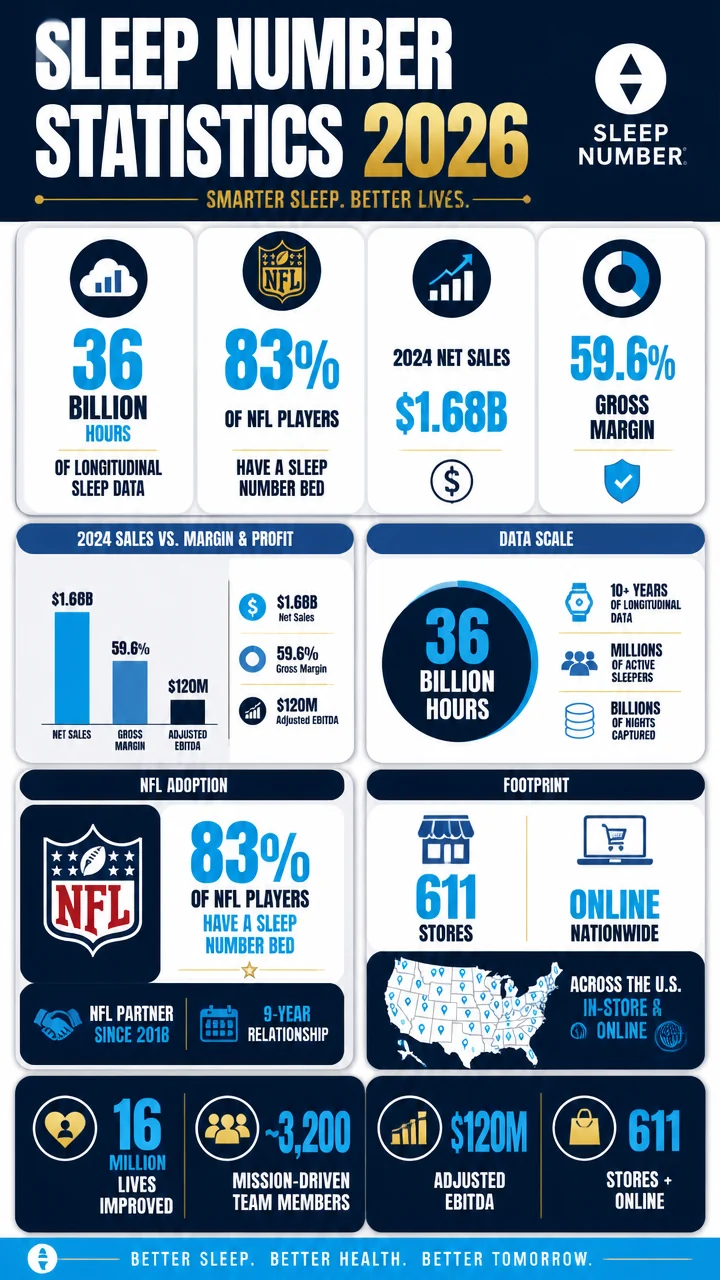
Big number: Sleep Number says its sleep wellness platform draws on 36 billion hours of longitudinal sleep data.
Fast fact: The company says 83% of NFL players had a Sleep Number bed based on eligible active roster purchases through December 13, 2024.
Key takeaway: In 2024, Sleep Number generated $1.68 billion in net sales, with 59.6% gross margin and $120 million in adjusted EBITDA.
Table of contents
- Sleep Number statistics at a glance
- Sleep Number revenue, margin, and profit trends
- Sleep Number quarterly performance table
- Sleep Number growth and cost-reduction statistics
- Sleep Number market footprint, stores, and team members
- Sleep Number sleep data and wellness platform scale
- Sleep Number NFL partnership and athlete adoption stats
- Sleep Number product and sleep-quality highlights
Sleep Number revenue, margin, and profit trends
Sleep Number’s financial trend line is a mix of soft top-line results and solid operating discipline.
Full-year 2024 sales declined from 2023, but gross margin stayed near 60% and operating expenses were materially lower than the prior year.
Why it matters: When a consumer brand is facing softer demand, margin stability and expense control become the difference between a manageable slowdown and a much deeper earnings reset.
Full-year 2024 net sales were $1.68 billion, down 11% year over year.
Full-year 2024 gross margin was 59.6%, up 190 basis points from the prior year.
Full-year 2024 adjusted EBITDA reached $120 million, while the company reported a $20 million net loss.
Operating expenses were $962 million before restructuring costs, down $88 million versus the prior year.
What the annual trend suggests
- Revenue contracted in 2024, but not catastrophically compared with the margin picture.
- Gross margin hovered close to 60% across the year, a sign of pricing power or product mix resilience.
- Expense discipline was a major theme, with management emphasizing cost reductions in both 2023 and 2024.
- Adjusted EBITDA remained positive, showing the business still had earnings capacity despite the sales decline.
Sleep Number quarterly performance table
Quarterly results show a company that finished 2024 with stable margins, then entered 2025 with lower sales and a weaker year-over-year comparison.
| Period | Net sales | YoY change | Gross margin | Adjusted EBITDA | Net result |
|---|---|---|---|---|---|
| Q1 2024 | $470 million | Not stated | Not stated | $37 million | Not stated |
| Q2 2024 | $408 million | Not stated | 59.1% | $28 million | Not stated |
| Q3 2024 | $427 million | Not stated | 60.8% | $28 million | Not stated |
| Q4 2024 | $377 million | Down 12% | 59.9% | $26 million | Not stated |
| Q1 2025 | $393 million | Down 16% | Not stated | Ahead of expectations | $8.6 million net loss |
| Q2 2025 | $408 million | Down 11% | 59.1% | $28 million | $25 million net loss |
| Q3 2025 | $343 million | Down 19.6% | 59.9% | $13 million | $40 million net loss |
Stat highlight: Sleep Number’s Q3 2025 net sales were $343 million, the weakest quarterly revenue figure in the supplied dataset.
Three important patterns stand out from the table:
- Q2 2024 and Q2 2025 were both $408 million, suggesting a flat quarter two-to-quarter two comparison in absolute sales even though the company described Q2 2025 as down 11% year over year.
- Q3 2024 gross margin hit 60.8%, the highest quarterly margin in the data.
- Q3 2025 adjusted EBITDA fell to $13 million, well below the $28 million posted in Q2 2025 and Q3 2024.
Sleep Number growth and cost-reduction statistics
Sleep Number’s own releases show a business that has spent the last several quarters prioritizing restructuring and operating efficiency.
Big number: In Q3 2025, operating expenses were reduced by $44.8 million, or 18%, year over year before restructuring and other non-recurring costs.
The longer cost-reduction story is even more striking:
- In 2023, Sleep Number said it reduced operating expenses by $85 million.
- It expected a further $40 million to $45 million of expense reductions in 2024 from its 2023 baseline.
- It also projected two-year operating expense reductions of approximately $130 million before restructuring costs.
- By full-year 2024, operating expenses were down another $88 million versus the prior year before restructuring costs.
Q4 2024 operating expenses were $219 million before restructuring costs, compared with $247 million in Q4 2023.
Q2 2025 operating expenses were $234 million before restructuring charges, while Q3 2025 operating expenses were reduced by $44.8 million year over year.
Why it matters: For a retailer with falling sales, these reductions help explain how gross profit and adjusted EBITDA have remained comparatively resilient.
Sleep Number market footprint, stores, and team members
One of the clearest signs of scale in the Sleep Number statistics dataset is the company’s physical and human footprint.
The number of stores and team members moved around during 2025, but the company remained a national direct-to-consumer retailer with hundreds of locations.
| Date / source | Team members | Stores | Channel note |
|---|---|---|---|
| Investor overview | Approximately 3,200 | 611 | Stores and online sales |
| March 5, 2025 results | 3,700 | Almost 640 | Not stated |
| Q1 2025 Form 10-Q | 3,600 | Not stated | Not stated |
| Q2 2025 results | 3,400 | 630 | Direct-to-consumer selling |
| Q3 2025 results | 3,200 | 611 | Not stated |
The pattern here is straightforward: Sleep Number reported a workforce ranging from 3,200 to 3,700 mission-driven or dedicated team members, alongside a retail footprint that stayed in the 611 to almost 640 stores range.
- March 5, 2025: 3,700 team members and almost 640 stores.
- Q2 2025: 3,400 team members and 630 stores.
- Q3 2025: 3,200 team members and 611 stores.
Fast fact: Sleep Number’s investor overview also says these team members helped support 611 stores and online sales.
Sleep Number sleep data and wellness platform scale
If the financial results show a mature retailer under pressure, the data platform numbers show a company trying to widen its moat.
Big number: Sleep Number says its sleep wellness platform is built on 36 billion hours of longitudinal sleep data.
That figure is notable because it gives the brand a language that goes far beyond mattress retail.
The company is not just selling beds; it is presenting itself as a sleep technology and wellness company with a massive installed-data base.
The dataset also contains a prior benchmark from Q1 2025 materials, when the company said it had 33 billion hours of longitudinal sleep data.
That suggests a jump of 3 billion hours in the company’s stated data scale across the supplied reporting periods.
Sleep Number’s value proposition in numbers
- 16 million lives improved, according to the company’s investor overview.
- 36 billion hours of longitudinal sleep data powering the wellness platform.
- 33 billion hours was the Q1 2025 data figure, showing the scale already in the tens of billions.
Why it matters: In a category where consumers often compare comfort and price, Sleep Number is trying to compete on measurable outcomes and proprietary sleep intelligence.
Sleep Number NFL partnership and athlete adoption stats
Sleep Number’s NFL relationship is one of the clearest examples of how the brand uses partnerships to reinforce credibility.
In 2025, it said it was the Official Sleep + Wellness Partner of the NFL, and a 2026 announcement noted that the relationship had been in place since 2018.
That makes it a nine-year relationship in the 2026 announcement framing.
Fast fact: Sleep Number said 83% of NFL players had a Sleep Number bed, based on eligible active roster purchases through December 13, 2024.
That is a powerful adoption figure in any consumer category, especially one tied to elite sports performance and recovery.
- 2018: The NFL partnership began.
- 2025: Sleep Number identified itself as the Official Sleep + Wellness Partner of the NFL.
- 2026 announcement: The relationship was described as nine years long.
- 83% of NFL players had a Sleep Number bed based on eligible active roster purchases through December 13, 2024.
Why it matters: For a premium mattress brand, athlete penetration works as social proof, brand storytelling, and product validation at once.
Sleep Number product and sleep-quality benchmarks
Sleep Number’s 2025 J.D.
Power release gives the clearest product-performance claim in the dataset: the company said its Climate360 smart bed sleepers get 52.5 minutes more restful sleep per night based on average SleepIQ data from 10/24 to 1/25.
It also said Climate360 programs were scientifically shown to improve sleep quality in the same release and that Sleep Number was the most awarded mattress brand in the J.D.
Power 2025 U.S.
Mattress Satisfaction Study.
Stat highlight: 52.5 minutes more restful sleep per night is the standout product outcome figure in the dataset.
Key product claims to know
- 52.5 minutes more restful sleep per night for Climate360 smart bed sleepers, based on average SleepIQ data from 10/24 to 1/25.
- Climate360 programs were said to be scientifically shown to improve sleep quality.
- Sleep Number said it was the most awarded mattress brand in the J.D.
Power 2025 U.S.
Mattress Satisfaction Study.
Sleep Number annual sales history and recent baseline changes
Looking across the annual figures, Sleep Number’s sales base has clearly come down from its 2022 peak, with 2024 marking a lower but still very large run rate.
| Year | Net sales | Additional note |
|---|---|---|
| 2022 | $2.11 billion | Diluted EPS of $1.60 |
| 2023 | $1.88 billion | Diluted loss per share of $0.68 |
| 2024 | $1.68 billion | Adjusted EBITDA of $120 million |
The three-year pattern is a clean one:
- 2022: $2.11 billion in net sales.
- 2023: $1.88 billion in net sales, still above the 2024 level.
- 2024: $1.68 billion in net sales, down 11% year over year.
Pull quote: Sleep Number’s recent story is less about growth and more about “defending the margin base while managing a smaller sales pool.”
Sleep Number quarterly benchmarks that stand out
Some of the most useful statistics in the dataset are the quarter-specific benchmarks, because they show the operating rhythm beneath the headlines.
- Q1 2024 net sales: $470 million, with adjusted EBITDA of $37 million.
- Q2 2024 net sales: $408 million, with a 59.1% gross margin and $28 million adjusted EBITDA.
- Q3 2024 net sales: $427 million, with a 60.8% gross margin and $28 million adjusted EBITDA.
- Q4 2024 net sales: $377 million, with a 59.9% gross margin and $26 million adjusted EBITDA.
- Q2 2025 total retail average revenue per smart bed unit: $5,880 in the quarter-by-quarter table.
These numbers show that the company’s revenue is still sizable on a quarterly basis, but the unit economics and margin performance are now just as important as total sales.
At a glance: Across the supplied quarter data, gross margin repeatedly sits near 59% to 61%, a relatively tight and noteworthy band for a consumer durables retailer.
Sleep Number financing, leverage, and liquidity signals
The dataset also includes a key balance-sheet signal: Sleep Number said its amended bank agreement ran through 2027 after the Q3 2025 amendment.
That matters because credit flexibility can become crucial when revenue trends are soft and restructuring is ongoing.
In Q3 2024, the company reported a leverage ratio of 4.2x EBITDAR versus a 5.0x covenant maximum.
That puts the company below the ceiling, but not by a comfortable margin for a business under sales pressure.
- 2027: End date of the amended bank agreement after the Q3 2025 amendment.
- 4.2x EBITDAR: Q3 2024 leverage ratio.
- 5.0x: Covenant maximum in the same period.
Why it matters: A long-dated bank agreement gives management room to execute cost initiatives and adjust to demand without immediate refinancing pressure.
Sleep Number statistics FAQ-style quick hits
How many hours of sleep data does Sleep Number have? The company says its platform draws on 36 billion hours of longitudinal sleep data.
How many people does Sleep Number say it has improved? It says its innovations have improved 16 million lives.
How widespread is Sleep Number among NFL players? The company says 83% of NFL players had a Sleep Number bed based on eligible active roster purchases through December 13, 2024.
What was Sleep Number’s 2024 revenue? Full-year 2024 net sales were $1.68 billion.
What was Sleep Number’s strongest quarterly margin in the dataset? 60.8% in Q3 2024.
What was the standout sleep-quality claim? Climate360 smart bed sleepers get 52.5 minutes more restful sleep per night based on average SleepIQ data from 10/24 to 1/25.
Sleep Number data points worth remembering
- $2.11 billion in full-year 2022 net sales.
- $1.88 billion in full-year 2023 net sales.
- $1.68 billion in full-year 2024 net sales.
- 59.6% full-year 2024 gross margin.
- $120 million full-year 2024 adjusted EBITDA.
- $343 million Q3 2025 net sales.
- 36 billion hours of longitudinal sleep data.
- 83% NFL player penetration.
- 52.5 minutes more restful sleep per night for Climate360 sleepers.