Humidifier statistics at a glance
Humidifiers are simple in concept, but the numbers behind them are surprisingly important.
The biggest story in the latest humidifier statistics is that the safest indoor humidity range is narrow, while product performance, runtime, and recall history vary widely.
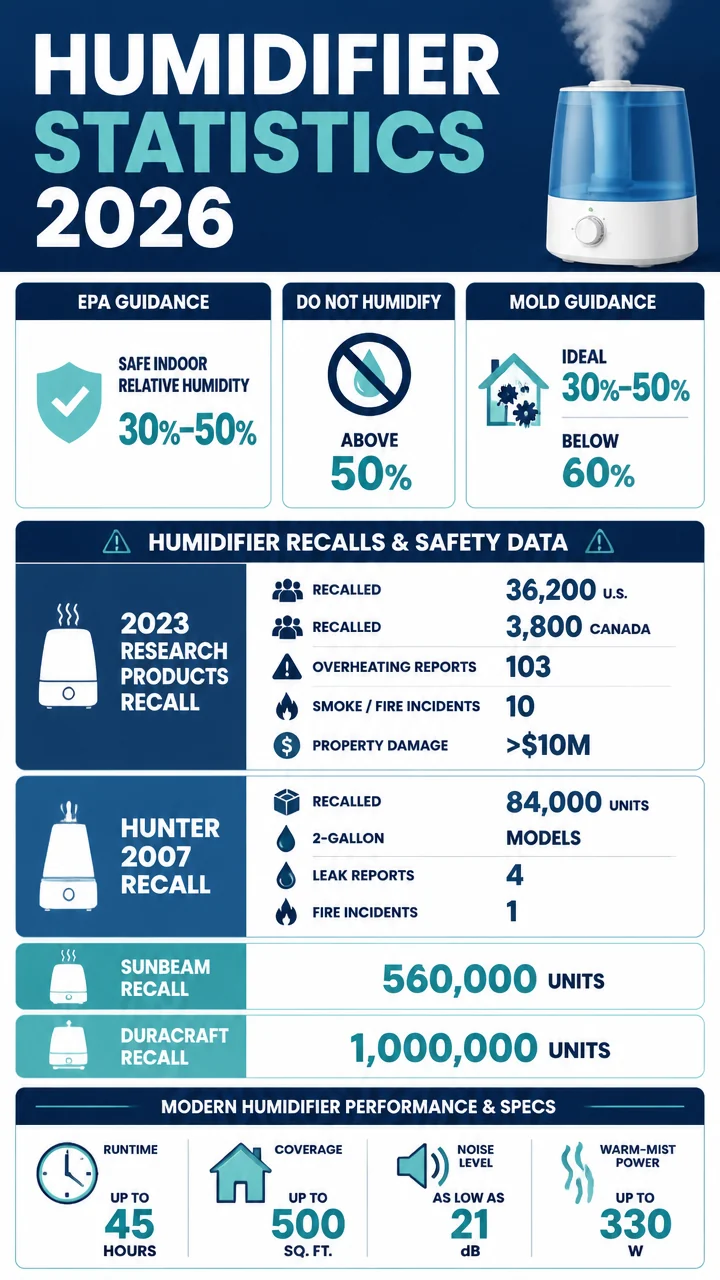
- 30% to 50% is the EPA’s advised indoor relative humidity range.
- The EPA also says not to humidify indoor air above 50% relative humidity.
- Major recalls have ranged from 13,000 units to about 1 million units.
- Modern humidifiers can run as long as 45 hours and cover up to 500 sq. ft.
- Noise levels can be as low as 21 dB, while some warm-mist models draw up to 330W.
Humidifier statistics table of contents
- Indoor humidity benchmarks and safety guidance
- Humidifier recall statistics and risk history
- Humidifier specs and performance comparisons
- Capacity, runtime, coverage, and noise benchmarks
- Fast facts and notable humidifier stats
Humidifier statistics on indoor humidity targets and safety
The most important humidifier statistic is not about a machine at all: it is about the air you breathe.
The EPA advises keeping indoor relative humidity between 30% and 50%, and it specifically says not to humidify indoor air above 50% relative humidity.
Humidity that climbs too high can create the conditions that make moisture problems harder to control.
The EPA mold guidance reinforces this by describing ideal indoor relative humidity as 30% to 50% and below 60%.
That range is worth remembering because it explains the real job of a humidifier: add just enough moisture to improve comfort without pushing indoor air into a risky zone.
- EPA recommended range: 30% to 50%
- EPA upper limit: do not humidify above 50%
- Mold guidance target: 30% to 50% and below 60%
Big number: The difference between comfortable indoor air and overly damp air can be just a few percentage points, which makes precision more important than maximum output.
Humidifier recall statistics: the biggest safety stories
Humidifier recall statistics show that safety issues have been a recurring theme across decades.
The supplied recall data includes steam, warm-mist, and glow-in-the-dark models, with recall sizes ranging from relatively small to massive.
- The 2023 Research Products steam humidifier recall covered about 36,200 units in the U.S. and 3,800 additional units in Canada.
- That recall received 103 overheating reports and included 10 smoke or residential fire incidents.
- The recall was associated with more than $10 million in damage.
That 2023 case stands out because it links a mid-sized recall with a large number of overheating reports and substantial property damage.
The numbers point to why humidifier maintenance and product design matter as much as capacity or runtime.
Major humidifier recalls by unit count
| Product / recall | Units covered | Notable reported issues |
|---|---|---|
| Duracraft humidifier recall (1997) | About 1 million | Recall size was the largest in the supplied dataset |
| Sunbeam glow-in-the-dark humidifier recall (2000) | About 560,000 | Large consumer recall |
| Hunter humidifier recall (2002) | About 100,000 | Recall size above six figures |
| Hunter Warm Mist Carefree humidifier recall (2007) | About 84,000 | Four water leaks and one fire report |
| Research Products steam humidifier recall (2023) | About 36,200 U.S. units; 3,800 in Canada | 103 overheating reports; 10 fire incidents; more than $10 million in damage |
| Toastmaster Edison humidifier recall (1985) | About 13,000 | Five fire or failure reports before the recall |
One of the biggest contrasts in the recall data is scale.
The Duracraft recall reached about 1 million units, while Toastmaster’s 1985 recall covered about 13,000 units.
That is a difference of roughly two orders of magnitude, showing how recall events can vary dramatically in reach.
The larger recalls are not just bigger in volume; the dataset also shows direct safety concerns such as leaks, overheating, smoke, and fires.
In other words, humidifier risk is not hypothetical in the recall record.
Humidifier statistics on performance: tank size, runtime, and coverage
For consumers, the most useful humidifier statistics often come down to how long a model runs, how much space it covers, and how much water it holds.
The dataset shows that these three factors vary widely across brands and product types.
- Largest tank listed: 4.5L on the Levoit OasisMist 450S
- Longest runtime listed: 45 hours on the Levoit OasisMist 450S
- Largest room coverage listed: up to 500 sq. ft. on the Crane digital warm and cool mist humidifier
- Quietest listed: 21 dB on the Levoit Neo 450
These numbers matter because a humidifier that is ideal for a small bedroom may not be enough for a larger living room, and a model that lasts all night may still be underpowered for open-plan spaces.
Device comparison table
| Model | Tank capacity | Runtime | Coverage | Noise / power note |
|---|---|---|---|---|
| Levoit Neo 450 | 4.2L | Up to 42 hours | 376 ft² | 21 dB |
| Levoit Neo 450S | 4.2L | Up to 42 hours | 376 ft² | App and voice control via VeSync, Alexa, and Google Assistant |
| Levoit OasisMist 450S | 4.5L | Up to 45 hours | 215–430 ft² | Under 26 dB on low cool mist; under 41 dB on high warm mist |
| Vicks V750 Warm Mist Humidifier | 1.0 gallon | Up to 24 hours | Designed for medium-large rooms | Two output settings; filter-free |
| Crane personal ultrasonic humidifier | 0.4 gallon | Up to 18 hours | Up to 160 sq. ft. | 120V AC input; 18V DC output |
| Crane warm mist humidifier | 0.5 gallon | Up to 13 hours | Not listed | 330W |
| Crane digital warm and cool mist humidifier | 1.3 gallon | Up to 24 hours | Up to 500 sq. ft. | Warm and cool mist |
Pull quote: The best-performing humidifier statistics in this dataset are the OasisMist 450S’s 45-hour runtime and the Crane digital model’s 500 sq. ft. coverage.
Humidifier statistics by tank size and runtime
Tank size and runtime do not move in perfect lockstep, but they do reveal a clear pattern: larger tanks generally support longer operation.
The biggest tanks in the dataset are tied to the longest runtimes.
- Levoit OasisMist 450S: 4.5L tank, up to 45 hours
- Levoit Neo 450 and 450S: 4.2L tanks, up to 42 hours
- Crane digital warm and cool mist: 1.3-gallon tank, up to 24 hours
- Vicks V750: 1.0-gallon tank, up to 24 hours on low
- Crane personal ultrasonic: 0.4-gallon tank, up to 18 hours
- Crane warm mist: 0.5-gallon tank, up to 13 hours
One takeaway is especially useful for shoppers: smaller models can still last a full day, but the longest all-night-and-beyond runtimes sit at the top end of the capacity range.
If you want fewer refills, runtime matters as much as mist output.
A model with a 4.5L tank and 45-hour runtime is built very differently from a compact 0.4-gallon, 18-hour personal unit.
Humidifier statistics on coverage and room size
Coverage is one of the clearest ways to separate personal humidifiers from room humidifiers.
The dataset includes everything from a personal unit covering 160 sq. ft. to a digital warm and cool mist model covering up to 500 sq. ft.
Coverage benchmarks
- Up to 160 sq. ft.: Crane personal ultrasonic humidifier
- 376 sq. ft.: Levoit Neo 450 and 450S
- 215–430 sq. ft.: Levoit OasisMist 450S
- Up to 500 sq. ft.: Crane digital warm and cool mist humidifier
That spread suggests a simple sizing rule hidden inside the statistics: personal humidifiers are for a tight footprint, while the larger models are positioned for bedrooms, family rooms, and larger shared spaces.
500 sq. ft. is the top coverage figure in the dataset, and it belongs to the Crane digital warm and cool mist humidifier.
Humidifier statistics on mist output, sound, and power
Output, noise, and power draw are easy to overlook, but they influence the everyday experience of using a humidifier.
The dataset shows that quiet operation and high output can coexist, though not always in the same product.
- 270 mL/h: Levoit Neo 450 and 450S mist output
- 46.8 inches: maximum mist projection height on the Levoit Neo 450
- 21 dB: operating noise on the Levoit Neo 450
- Under 26 dB: Levoit OasisMist 450S on low cool mist
- Under 41 dB: Levoit OasisMist 450S on high warm mist
- 280W: power rating of the Levoit OasisMist 450S
- 330W: power draw of the Crane warm mist humidifier
Big number: The quietest figure in the dataset is 21 dB, which helps explain why many shoppers prioritize ultrasonic models for bedrooms and nurseries.
The power data also shows a practical difference between designs.
Warm-mist models tend to carry visible electrical demands, with the Crane warm mist humidifier listed at 330W and the Levoit OasisMist 450S at 280W.
Humidifier statistics by model type and smart features
The dataset is not just about size and runtime; it also reveals how feature sets are changing.
The Levoit Neo 450S adds app and voice control through VeSync, Alexa, and Google Assistant, which puts it in the smart-home category rather than the basic appliance category.
- Levoit Neo 450S: app and voice control
- Vicks V750: filter-free design
- Crane digital warm and cool mist: warm and cool mist in one unit
- Levoit OasisMist 450S: compact size at 10.8 x 6.0 x 11.97 inches and 5.3 lb
These features matter because the humidifier market is no longer only about moisture output.
Consumers are also choosing between simple maintenance, smart control, portability, and multi-mode operation.
Humidifier statistics on model dimensions and portability
Physical size can be a deciding factor, especially for bedside use.
Among the more detailed dimensions provided, the Levoit OasisMist 450S measures 10.8 x 6.0 x 11.97 inches and weighs 5.3 lb.
That compact profile helps explain why the unit can combine a relatively large 4.5L tank with a manageable footprint.
For shoppers comparing desktop or nightstand placement, the size-to-runtime ratio is one of the most attractive numbers in the dataset.
5.3 lb is light enough to move easily, yet the OasisMist 450S still reaches 45 hours of runtime and covers 215–430 sq. ft.
Humidifier statistics that stand out most
Some figures are more quotable than others because they immediately signal scale, safety, or convenience.
These are the humidifier statistics most likely to stick with readers:
- 30% to 50% — EPA’s advised indoor humidity range
- Above 50% — EPA says not to humidify indoor air beyond this point
- About 1 million — Duracraft recall size in 1997
- 103 — overheating reports in the 2023 Research Products recall
- More than $10 million — damage linked to that recall
- 45 hours — top runtime in the dataset
- 500 sq. ft. — top coverage figure in the dataset
- 21 dB — quietest noise figure listed
Pull quote: The strongest pattern in the data is clear: humidifiers are most useful when they are sized to stay within the EPA’s 30% to 50% guidance, not when they simply produce the most mist.
What the humidifier statistics say shoppers should watch
The dataset suggests a practical way to read humidifier product pages and safety guidance together.
Focus on the figures that affect real use, not just marketing language.
- Humidity range: keep indoor RH near 30% to 50%
- Runtime: longer runtimes reduce refills
- Coverage: match the unit to the room size
- Noise: lower dB matters in bedrooms and nurseries
- Power: warm-mist models can draw significantly more electricity
- Recalls: product history matters for safety awareness
For readers comparing models, the numbers point to a simple pattern: the best humidifier is rarely the most powerful one.
It is the one that fits the room, stays within the EPA’s range, and avoids the safety and maintenance problems that show up in the recall record.